Members
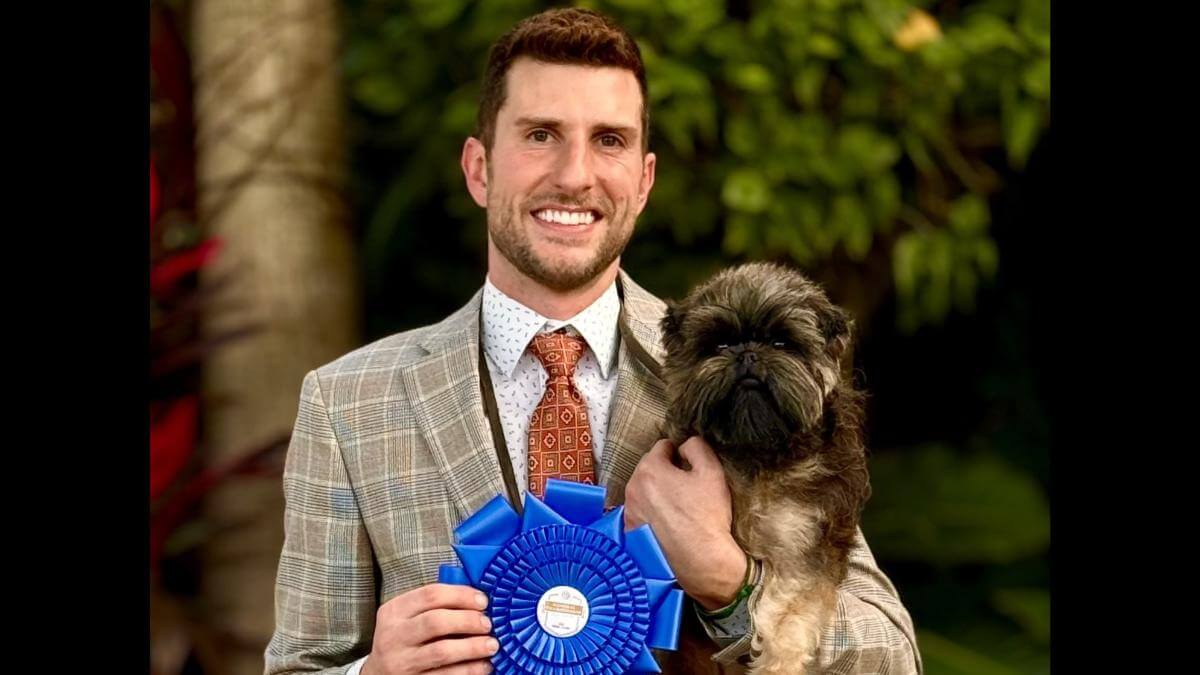
Matthew Mullin of Limelite Affenpinschers shares insight on breeding, judging, public perception, and preserving rare breeds.
The Weekly Brief
The best of SHOWSIGHT editorials, weekly wins, and breeder commentary — delivered to your inbox every Sunday morning.
Matthew Mullin
1. I started in purebred dogs with Australian Shepherds in 2001. My first dog aced his puppy classes and I was quickly competing in Obedience, then Agility, and shortly after I got my first “show dog” and began Conformation. My partner, AJ Tavares, and I live in southwest Washington State, breeding under the kennel prefix Limelite.
2. In Affenpinschers, a monkey-like appearance is of utmost importance. These dogs have a domed topskull, dark, round eyes, a muzzle the length of the distance between their eyes which does not tip up nor down (Affenpinschers are not brachiocephalic), and an underbite that gives a pouty lip. They are square and sturdy with harsh hair, particularly on the body. They were bred with a purpose: a kitchen ratter and petite farm dog, and the Breed Standard requires that they are sound. Beyond general appearance, correct temperament is key. They are comical and think a lot of themselves. Our Standard references personality in several sections, and anyone who has owned an Affen knows that half the dog is in their character!
3. With small litter sizes and sparse breeders, Affenpinschers can be tricky to acquire. There does seem to be enough homes to support litters. I don’t breed frequently enough to take deposits, and many times I will follow up with a home about a potential litter only to find out they ended up with a Yorkshire Terrier or Pomeranian, or something else. I will say, inquiries always increase after televised dog shows, as if the potential buyer finally had an opportunity to discover the breed. I would have to think the same is true for other rare breeds. We need more televised dog shows, and AKC.tv should really consider traditional social media livestreams rather than solely through the app that the general public is not downloading.
4. New technologies in science should be utilized, as the more information we have as breeders, the better. With that said, I do worry that rather than working around less desirable testing, more and more dogs will be eliminated from breeding stock and will result in bottlenecking in already limited gene pools. As far as new technologies in communication, I am surely underutilizing social media, so for now it stays on my to-do list.
5. The public perception of purebred dogs needs an overhaul. We are letting animal rights activists win the argument, and their argument is not a good one. When the general public pictures a breeder, they are not picturing the person who is likely reading this article. They are picturing the tear-stained, matted puppies historically accompanied by a Sarah McLaughlin voiceover. Even friends outside of the “dog world” think my well-loved dogs are more of an anomaly, not realizing the lengths we all go to protect each dog we’ve bred, how our parent clubs are running rescue, or how efforts are made to get any of our breeds out of a shelter.
In recent times, the laws that seemed most likely to pass have involved greater licensure for the breeder, a cost that could likely only be absorbed by a more commercial breeder, the type of breeder more suitable to be targeted. In the extreme, we would be left with high-volume breeders, which is gross in any species. Man’s best friend doesn’t exist without breeders. Celebrities seem to feature their “rescue” and hide their well-bred dog, if they were even brave enough to buy one. One of my favorite comedians, Chelsea Handler, has had a string of Chow Chows and Chow mixes over the decades, always a stated rescue. Her current dog looks relatively well bred and she seems over-the-moon. Where does she think he came from? We need Hollywood back on our side. Somebody call Martha Stewart!
6. We have some phenomenal judges, both new and old, both Breed/Group specialists and all-breed judges. With that said, I am extremely concerned with what qualifies one to judge and the seeming complete lack of follow up when a judge shows that they are incompetent. It seems that the goal for many is to maximize the number of breeds for which they are approved. Cramming information to regurgitate is not creating experts. When a judge struggles with both type and general construction, why did I just pay for an evaluation? Where did all of the experts go? When my Affen wins, I want her to win because the judge really knows how well she fits the Breed Standard.
7. I’m not sure if this is relatively new, or if I’ve only learned of it in the past few years, but it is of great benefit that breed icons without a judging license can be approved to judge a Specialty show by request of the parent club.

Meet the Breeders