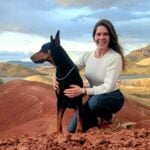


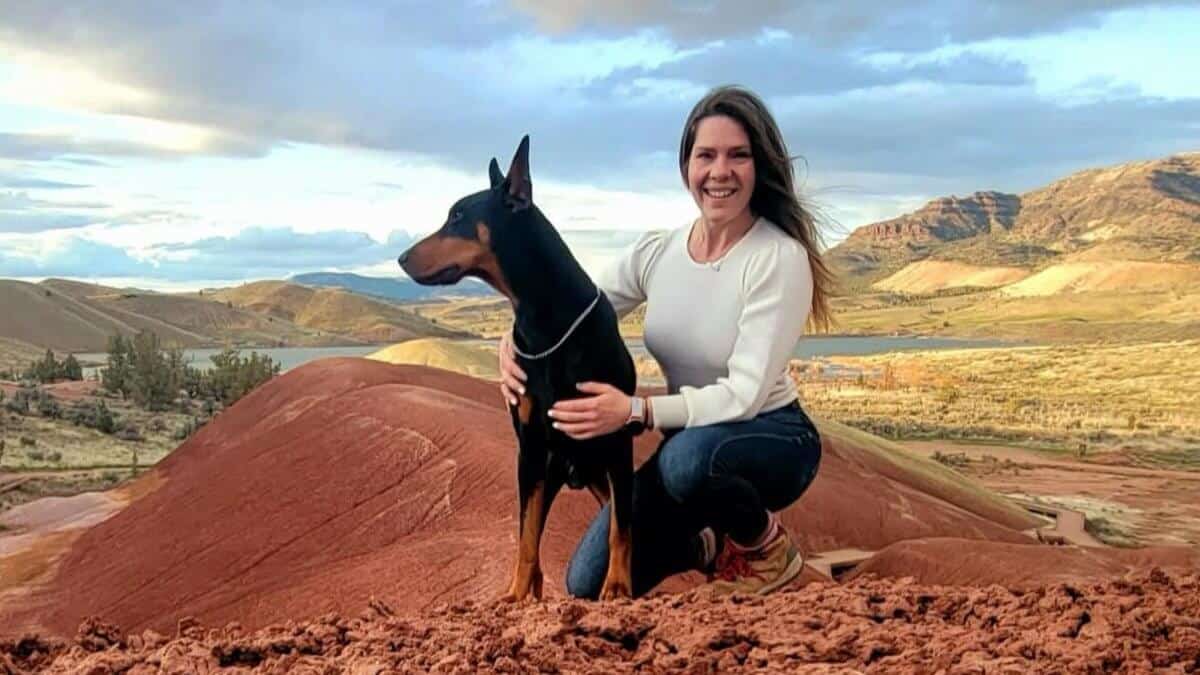
Cheyenne Calvert: I actually started in 4-H. I was involved in dogs, Home Economics, and horses. I showed my first dog, a Labrador Retriever that my mom bred, at the Clark County Fair Pee-Wee Competition when I was three years old; I vividly remember “Tessi” pulling me off my feet and dragging me, face first, across the ring to the exit, but I never let go of the leash and was determined to prove I could handle her on my own! I do think they let me borrow a Shetland Sheepdog at the next fair, though. My family slowly became more involved in AKC, and when I was nine years old I was allowed to get my own dog. The choosing process was brutal; I would sit ringside and point at every cute dog to walk by and say, “I want that one, no, that one! Okay, I definitely want that one!” After announcing that I wanted everything from a Saluki to a Pug, my mom clarified that I could get anything I wanted as long as it was in the Sporting Group. I landed on an English Cocker Spaniel and was given my first show dog, a beautiful red male, by Penny and Richard McKay. “Tucker” got his last Major to become a Champion with my older sister Jessica. The next day, I showed him in the classes to hold the Major. Many of you know what that entails. I was asked to “show him down,” and while I was no expert handler yet, I turned myself into the worst of them; sprinting around the ring, standing there and staring into the abyss during my stacks, and even letting Tucker jump on and off the table himself. Despite my “impeccable” performance, Mr. Trotter simply wasn’t having it. He knew the dog was beautiful and he was patient and kind enough to stop me in the middle of the ring and give me an in-depth handling lesson. I was so conflicted: Listen to the judge or do what was asked of me from my competitors? I tried to meet somewhere in the middle, and Mr. Trotter awarded me Winners Dog and Best of Winners for a 5-pt Major! I went on to win my first Group Placements on that dog as well as become a top-ranked Junior, and I was even the youngest person competing in Juniors at Westminster my first year attending. Since then, I have continued to own and breed English Cockers under the guidance of Kay and Doug Belter, while also expanding into German Shorthaired Pointers and my current Doberman Pinscher. While all this was going on, my sister had begun to work for a Professional Handler, the late-great, Randy Schepper. I followed them around everywhere until, one day, he asked me if I wanted to work there too. I exclaimed, “Yes, of course!” Having felt like I already worked there, it was really a no-brainer. I worked for him from 10 years old to 20 years old. In that time, my family became less involved in dog shows, but my passion for the dogs and life on the road only grew. When I was 20, Randy told me I was ready. He wanted me to step out on my own, even sending one of his client dogs with me, a Keeshond named “Makani” for whom I had become the sole groomer. I truly owe all I know about handling, grooming, and integrity to Randy Schepper. After all these years, I am still incredibly passionate about my job. As someone who loves to travel, I actually love that going on long drives is part of my job. I try to make the most of this by visiting National Parks or other local treasures as often as possible. But what truly keeps me passionate about this sport is that I get to work with, and learn about, every breed out there! I’m always shocked to find myself falling in love with new breeds each year. From my feisty Terriers to my powerful and elegant Working dogs, I still feel like that kid saying, “I want them all!” But now, I don’t have to choose!
Cheyenne Calvert: Through my years working for Randy, it became clear that sportsmanship and integrity are the foundation of a true professional. Being a Professional Handler isn’t something you say you are, or that you get deemed because you printed your first rate sheet. It’s something you live, every day, no matter who is or isn’t watching. It’s being respectful of the judges and fellow competitors in and out of the ring. It is paying homage to the greats who shaped the path for us younger handlers today, while having the courage to stand up against inappropriate behaviors and patterns that have grown to become the norm. So much of our sport has become a “show,” with people performing only when they think others are watching. But being a professional means maintaining the same level of respect, care, kindness, and attention to detail when you’re taking care of dogs, tired and alone, at the end of a long day as you do when all eyes are on you in the Best in Show ring. The number one priority for the dogs in my care is always their safety. From their physical conditioning to their mental well-being, a happy and healthy dog will always perform better. With the many business demands on handlers, it’s easy to lose sight of the main point of what we do. The dogs are the stars of this show, and we are just here to make them shine.
Cheyenne Calvert: The most important aspect of preparation, to me, is building a bond and maintaining a flexible approach. As an All-Breed Professional Handler, I work with every breed, coat type, and temperament. There is absolutely no one-size-fits-all process that would work for all my dogs; rather, I tailor each process to the needs of each specific dog, from rolling the Norwich’s coat weekly, whether we have a break in shows or not, to biking the Boxer daily to keep her muscle tone in peak condition, to letting my Bouvier des Flandres nap between sets simply because he enjoys it. I’ll do whatever brings out the best in my dogs. Discovering each dog’s optimal routine can take time, but more specifically, it takes building a bond. You have to know what works best for your dog to get them to their peak performance.
Cheyenne Calvert: Over the years, I’ve seen encouraging growth in exhibitor education programs, especially coming from judges, which has helped to bridge the gap between “scary judge” and “scared novice handler.” In addition, social media has given a platform to further bridge gaps by making information and education programs more readily visible and accessible. However, I’ve also seen increased pressure created by social media. Your dog practically has to have their own social media presence and following to be successful these days. While social media can celebrate success and connect our community globally, helping to expand breeding pools and the overall consistency and quality of our breeds, it can also amplify negativity, cyber bullying, and soliciting to judges. Lastly, judging trends ebb and flow, but I feel confident that if breeders and handlers prioritize dogs that are correct to the Breed Standard, our sport will overcome dangerous trends in favor of true breed preservation.
Cheyenne Calvert: Coming from a 4-H background, I’m a strong believer in learning by doing. Through the years, I’ve had the opportunity to train many assistants. When possible, I take the time to give detailed instructions to each upcoming assistant, but there is always a crunch time when more becomes asked of them than they probably felt prepared for. It is in those moments, however, that I have seen assistants blossom from someone who can follow instructions well to someone who can problem solve efficiently on the spot while maintaining the standard for excellence I have set for our team. Not everything will go perfectly every time, but even failures or shortcomings are viewed as learning experiences for the next time. I find that no amount of talking about Breed Standards and ethical breeding will ever compare to the passion that gets lit through working with dogs and seeing the whole process, from a shaved-down puppy getting his first evaluation to the hours of hard work spent with training, poop scooping, and coat maintenance, to then seeing that same dog become a multiple Best in Show-winning Bouvier! In my opinion, it is after that spark has been ignited into passion that Juniors are more eager to learn more about our history and the importance of preservation breeding and functional soundness. We all start somewhere, and sometimes the kid with the backyard-bred dog, with no understanding of a well-bred dog, just needed someone to believe in their ability and potential to do more than the standard they set for themselves.
Cheyenne Calvert: There are many challenges facing our sport today, from the continually increasing cost of entries and travel to the loss of clubs and venues to host shows. But in my opinion, one of the most significant challenges facing the dog show community today is the growing popularity of “doodles” and other intentionally mixed dogs. With hundreds of new mixes being bred and heavily marketed, they are, increasingly, becoming the default choice for pet homes. This trend has widened the gap between the “show world” and the general dog-owning public. I think this comes from a lack of education about breed purpose, structure, temperament, and the predictability that only comes from generations of thoughtful breeding—as well as a negative connotation around “show dog people” and a lack of social media presence. The public often does not understand the value of health testing, pedigree research, and adherence to a Breed Standard because we have not always explained it in ways that resonate outside our circles. Breeders of mixes have somehow flipped the script from “adopt, don’t shop” to “shop designer,” boasting hundreds of doodle Instagram pages painting them as the best thing since sliced bread. Heck, some of them even get painted to look like sliced bread! Meanwhile, responsible show dog breeders, understandably, take a much more conservative approach to ensure their dogs don’t end up in poor conditions, which sometimes translates to the general public as inaccessible and snobby. I believe growth lies in a larger social media presence, highlighting the uniquely lovable characteristics of different breeds as well as maintaining a more approachable tone with the general public and a willingness to spend time teaching. With my generation being known for having as many dogs as kids, if we could tap into just a fraction of this dog-loving generation, I think there is an opportunity to revitalize dog shows.
I have been encouraged by recent social media posts following Westminster, highlighting the sweet and light-hearted moments that happen between TV cuts that remind people that even the most pristine show dog is just a beloved pet at the end of the day. I have also seen a resurgence in clubs hosting “Meet the Breed” events at their shows, and I know many local breed clubs that host fun and educational outings with their dogs in their local communities.

Cheyenne Calvert: As many may already know, my husband Jake died in 2023 after a four-year battle with cancer that paralyzed him from the chest down. He was a fit, healthy, active-duty Marine, and we were two months married when he was diagnosed. His family and I celebrated his 30th birthday without him. His determination to not just survive but to spend his last years truly living despite the odds has forever changed my life. We even learned how to paraglide together while he was paralyzed. I live each day now with the weight of grief but also with a vigor for life that only comes from the the stark realization that tomorrow is never promised. Through everything that happened those four years, I kept my foot in the dog show world, handling on occasion, but leaning more into training and grooming from home so that I could spend more time with him. It was a hard season of life that I would live again in a heartbeat to have him back. While he was alive, he continually talked about my future after him; most of the time I didn’t want to hear it, because I simply couldn’t stand to imagine it, but those conversations have truly carried me through the last few years, inspiring me to continue to live, find love again, and quite literally, fly. My family, friends, and church community have been, and continue to be, a vital support system for me as well. I find that having meaning and purpose outside of dog shows helps maintain a healthy perspective that we don’t live and die by the show results.
Cheyenne Calvert: I always have the great honor of working with many lovely clients and their dogs. Getting to train up the next set of rising stars always excites me! This year, I have four dogs in particular who are top-winning in their breeds and off to a great start in 2026: Thaddeus, the multiple Best in Show-winning Bouvier; Burke, the beautiful Rough Collie; Archie, America’s No. 2 Norwich last year at under two years old; and Shimmer, the No. 1 Boxer bitch bred by the late, great Wendy Betis and handled by Wendy to Grand Prize Futurity at the 2024 Boxer National. Wendy and I had talked about taking on a Boxer while my husband was still alive, but I told her I simply didn’t have the capacity to take on a top-winning Boxer at that time. After my husband’s passing, she contacted me again and said, “It’s time and I have just the bitch to make your name in this tough ring.” She was instrumental in the start of my career with Shimmer, and after her passing at the end of 2024, I have felt inspired to carry on a torch for Wendy and honor my husband’s wishes to thrive by fully leaning into these young dogs’ careers. Currently, the only option with a Boxer is to drive, so we have spent more time on the road than ever before and will continue to do so as we chase down dreams and work on fulfilling promises made.