


Home » The Science of Canine Coat Color From A to Z – Part 3: D is for Dilute: How Genes Turn Espresso Dogs into Lattes
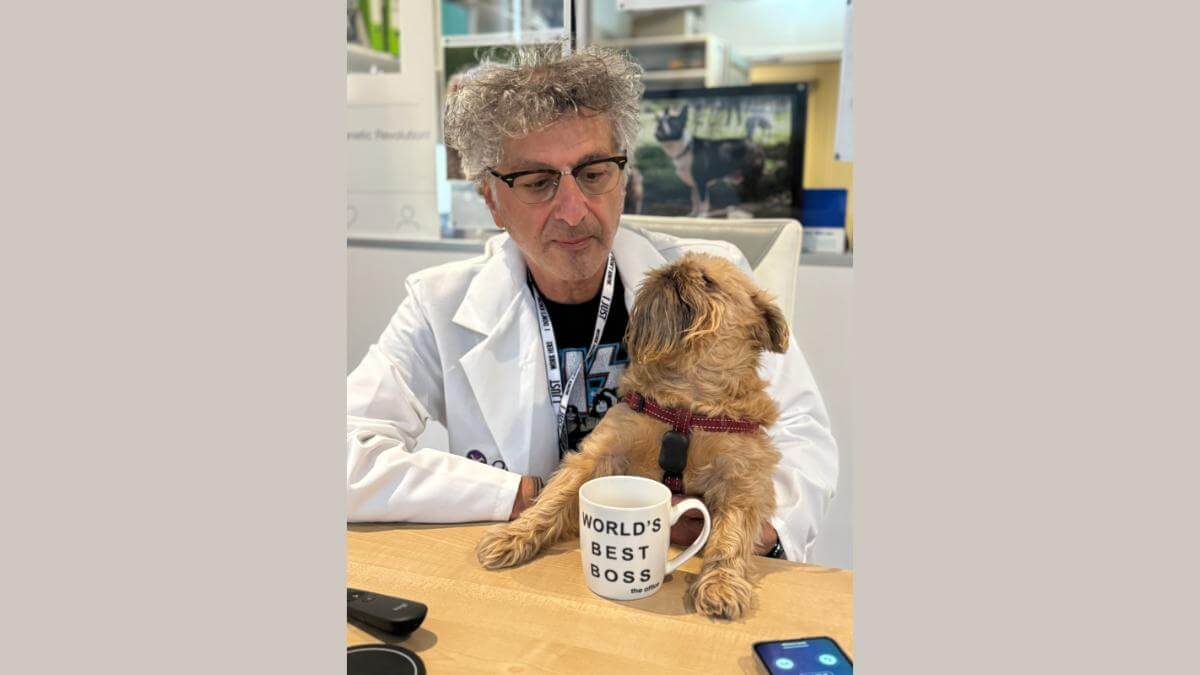
Charlie, my Boston Terrier, had many serious questions about life. Most of them involve chasing a ball, but occasionally he strays into genetics. One day, he parked himself in front of a handsome blue Staffordshire Bull Terrier and sighed, “Mary, if Genetic George can turn a black dog into a blue dog, can he also turn me into low-maintenance?”
Mary the Griffon didn’t even look up. “Charlie,” she said, “George can explain your DNA. He cannot fix your personality.”
And with that, welcome back to our A to Z journey through canine coat color. We’ve already met A for Agouti and B for Brown. This month, we arrive at D—the Dilute locus, the subtle tweak that can turn deep black into cool blue, rich brown into soft Isabella, and set breeders either dreaming or panicking.
Every dog starts with the same two pigments. Eumelanin is the “black-based” pigment that gives us black and, when modified, brown. Phaeomelanin is the “red-based” pigment that runs from deep red through gold to pale cream.
Genes such as A (Agouti) and B (Brown) decide where these pigments appear and which base shade they take. None of that, however, explains why a dog can be “blue” or “Isabella.” That softer, washed-out look belongs to D–the Dilute locus. D doesn’t choose between black or brown; it decides how strongly pigment is delivered into each hair. Think of it as the difference between a double espresso and a latte: same beans, different strength.
The D locus corresponds to a gene called MLPH (melanophilin). Inside pigment cells, color is packed into tiny parcels and moved along microscopic “railway tracks” so that it can be spread evenly through each hair. When MLPH works properly, pigment is delivered at full power and we see strong, dark eumelanin: solid blacks or rich browns.
Certain variants in MLPH slow that system down, so pigment isn’t distributed as efficiently and the coat looks softer and diluted. On paper, we write this as D for normal (non-dilute) and d for dilute. The key point is that d is recessive. A dog needs two copies—d/d—to show a dilute coat. A dog that is D/D or D/d will look non-dilute, even though D/d dogs quietly carry the dilute variant.
Because d is recessive, the inheritance pattern is simple but sneaky. Two dogs can look completely non-dilute and yet both carry d. Mate two carriers and, on average, one quarter of the litter will be dilute (d/d), half will be carriers (D/d) and one quarter will be clear (D/D). Mate a carrier to a clear dog and you’ll get carriers and clears, but no dilute pups. As Charlie put it: “Like my sock under the couch—hidden for months, then suddenly back to cause trouble.”
The D locus mainly affects eumelanin, the black-based pigment. A dog that would have been jet black with normal pigment (D/D or D/d) becomes blue or slate when it is d/d. A dog that is brown-based (b/b at the B locus) will, when combined with d/d, become the softer shade many call Isabella, lilac, or taupe, depending on the breed’s preferred language.
Dilution acts on whatever eumelanin pattern is already there. A black-and-tan dog can become blue-and-tan; a solid liver dog can become Isabella. A brindle or patterned dog based on black pigment will show the dilute version of that pattern.
Phaeomelanin, the red pigment, may look slightly dustier, but the big transformations—black to blue, chocolate to Isabella—are all about eumelanin. Or, as Mary observed while eyeing a row of “blue” Frenchies, “Same beans, more milk.”
Once you start looking, dilution appears in a wide range of breeds. The iconic “silver” of the Weimaraner is essentially a dilute brown layered over a very specific history. Greyhounds, Whippets, and Italian Greyhounds show elegant blue and Isabella shades. Staffords and Amstaffs have popular blue lines that pet buyers adore. Dobermans can be black or brown, and their dilute counterparts are blue and fawn (Isabella).
In some breeds, dilute colors are well established and clearly described in the Standard. In others, they pop up at the fringes, raising questions about selection, outcrossing, and long-term impact. That’s when a thoughtful breeder steps back from the excitement of a rare shade and asks, “What am I trading off to get this? Am I narrowing my gene pool? Am I ignoring type, temperament, or health just to produce a fashionable color?”
Mary’s view is blunt: “You can’t show off a fancy coat if the dog can’t move, can’t breathe, or can’t cope.”
One reason dilute dogs sometimes get a bad reputation is due to color dilution alopecia (CDA) and related hair-and-skin problems. Not every dilute dog will develop these issues, and not every dog with CDA is dilute, but there is a recognized association in several breeds and lines.
CDA often appears as thinning or patchy hair loss in dilute-colored areas, along with dry or flaky skin and a tendency to secondary infections.
Dilution itself is not a guaranteed health problem. Many dilute dogs have strong coats and healthy skin throughout their lifetime. Trouble appears when breeders chase color so hard that they repeatedly use the same dilute lines and overlook other aspects of health and structure. Over time, this can “package” skin issues, poor coats, or other recessive conditions into particular color families.
The sensible approach is to treat dilution like any other trait. Track the health of your dilute dogs across generations, note lines where CDA or chronic skin issues are common, and don’t be afraid to blend in non-dilute dogs with excellent structure and skin to dilute the problems, not just the pigment.
Once you understand the D locus, it becomes another useful lever in your breeding program rather than a source of surprises or arguments.
If dilute colors are allowed in your breed, knowing which dogs are D/D, D/d, or d/d lets you plan for, or avoid, blue or Isabella puppies with confidence. If your Standard excludes dilute, testing your core breeding dogs for carrier status helps you avoid producing disqualifying colors by accident.
If dilute colors are a valued feature in your line, testing can also help you avoid narrowing the gene pool. You might deliberately pair a wonderful dilute dog with a non-dilute partner who brings in stronger structure, healthier skin, or steadier temperament, even if that means some non-dilute puppies alongside your blues and Isabellas. Color should decorate a good dog, not distract from a poor one.
Charlie, who considers himself perfect regardless of genotype, has his own checklist: “Type, temperament, soundness, then color. And snacks. Always snacks.”
As regular readers know, Mary and Charlie insist that every letter in our A to Z comes with a practical payoff, not just theory. This month, they have authorized what they are calling a “D-Luxe” special.
One SHOWSIGHT reader will receive a complimentary coat color DNA package focused on key loci—including D (dilute), B (brown), and several core pattern genes—plus a short, written interpretation from yours truly explaining what those results mean for your future matings.
To enter, simply contact the email listed in this issue with your name, your breed, and the subject line “D is for Dilute.” If you’d like to amuse the judging panel (mostly Mary, with Charlie acting as union delegate), include a photo of your favourite dog—dilute or not—captioned as one of the following: “Team Blue,” “Team Chocolate,” or “Team Whatever-Is-Healthiest.”
Mary has declared herself firmly “Team Whatever-Comes-With-Snacks.” Charlie, after long deliberation, chose “Team Whatever-Cleans-Up-Best-After-the-Park.”
Next month, we’ll move on to E–the Extension locus, where we’ll unpack masks, recessive reds, and those dogs who hide all their black pigment in their skin while looking gloriously golden on the outside. Until then, remember: dilution doesn’t create pigment; it softens what’s already there. Used wisely, the D locus can add variety to your breed’s palette without sacrificing the most important thing of all—the sound, healthy, happy dog underneath the coat.