Members
AKC Judge Britt Jung explores the Sporting Group, highlighting the history, purpose, and defining characteristics of its 33 breeds.

Britt Jung
The Weekly Brief
The best of SHOWSIGHT editorials, weekly wins, and breeder commentary — delivered to your inbox every Sunday morning.
Photos provided by author.
The Sporting Group includes some of the most well-known and popular dog breeds. Most were originally bred to work alongside hunters to locate, point, flush, or retrieve birds and waterfowl. These dogs were bred to take direction from human handlers under high-distraction conditions. This makes them highly trainable, cooperative, and popular candidates for service dog and therapy work, in addition to their jobs as hunting companions. They are generally friendly, outgoing, and adaptable, making them top choices for active people and families with children. Functional attributes are typically the most important aspects of each Breed Standard; i.e., form follows function. In many Sporting breeds, you will see dogs in the show ring that also compete in the field. Due to their nature as working athletes, they have abundant energy and do best if given an outlet (physical and mental) for that energy. Many breed clubs in this Group warn that these dogs can become difficult for their owners without proper mental and physical stimulation.
The Sporting Group can be broken into categories based on how the dogs assist hunters in the pursuit of game. Those categories are pointers, retrievers, setters, and spaniels. In today’s world, these categories are not absolute. For example, many breeds are required to point and retrieve or flush and retrieve. The continental gundogs (in contrast to those dogs developed in the British Isles) are thought to be generalists due to the fact that on the European continent, hunters needed a dog that could do it all. In contrast, the hunters in the United Kingdom needed dogs to do one specific job exceptionally well. The continental gundogs tended to hunt more methodically and close to the handler than the wide-ranging pointers from the islands. They’re thought to be hard workers in the field and incredibly family-oriented dogs at home. In general, pointers are bred to find the game, and then their “point” is how they signal the location of the bird. Retrievers have to locate a fallen bird or waterfowl and retrieve it to the hunter in their soft, gentle mouths. The retrievers typically have water-resistant coats. The spaniels are smaller, more compact dogs and are built to work close to the hunter, pushing through dense brush and flushing birds for the hunter to shoot. They might be used in tandem with a pointing breed. Before the use of firearms became more prevalent, setters were known to crouch or lay down and “set,” which helped them avoid the nets that hunters threw to capture the birds the setters had located. Over time, it became important for hunters to see their dogs, and so setters were developed to have an upright point, like pointers. Some Sporting breeds have more “dual dogs” (those that excel in both the show ring and field events) than others, but it is fair to say that breeders and owners in all these breeds generally value the versatility and the functional abilities of their dogs. Of course, as guns came into being and societies advanced, hunters and owners have used more Sporting breeds for the same functions.
For the purpose of competing in AKC Field events, the dogs in this Group are eligible for Pointing events, Retrieving events, or Flushing events. The Lagotto Romagnolo is the only Sporting breed that does not compete in AKC Field events.
What follows are very brief summaries of each of the 33 Sporting breeds, with a focus on the breed hallmarks or defining characteristics.
While pointers vary significantly in coat type, geographic origin, and size, their shared characteristics are rooted in a specific, ancient hunting partnership with humans. The overarching goal of a pointing breed is to cover large areas of open terrain ahead of the hunter, locate the scent of hidden gamebirds, and freeze to pinpoint the bird’s exact location without flushing it. Today, pointers are often also used to retrieve shot birds.
The Bracco Italiano is an ancient Italian gundog with many unique characteristics. This is a powerful, large breed with an extended, fast or flying trot. Think power without lumber. When hunting, it’s as if the dog is being pulled by its nose. The head, a hallmark of the breed, is an elongated oval as seen from the top or an open arch in profile, and is more reminiscent of a hound than a pointer but still with a regal appearance. This is a narrow head on a wide body. The topline is one of two parts, with a clear break at the 11th dorsal vertebra. The skin is tough and elastic to withstand the rugged terrain. Bracchi have a short, dense coat that can be solid white, white with orange markings (never lemon), or white with brown markings (think milk chocolate with a metallic sheen, not liver).
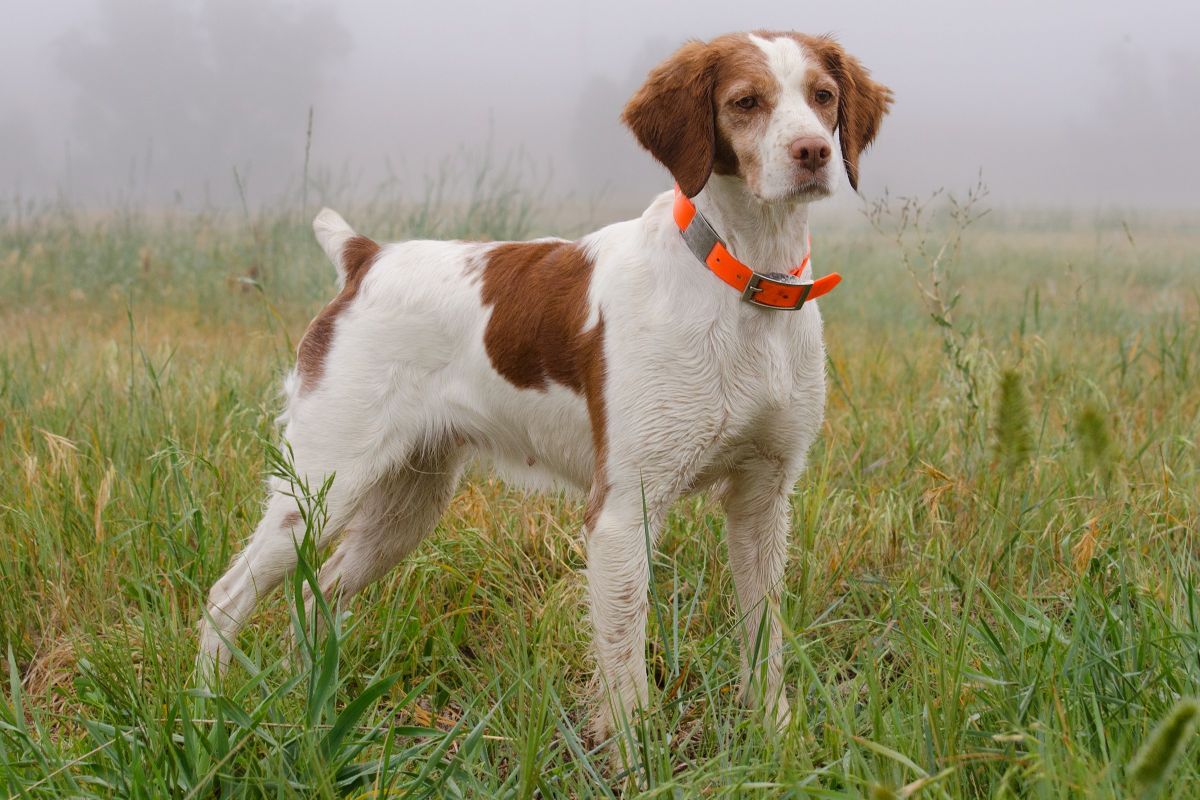
The Brittany hails from the Brittany region of France and derives from crosses between spaniels and English Setters. While the Brittany is considered a medium-sized dog, it is the smallest of the pointers. This is a compact, closely knit, leggy dog that covers ground with agility. When trotting, the dog should show ground-covering side gait where the hind foot steps into or beyond the print left by the front foot. The stewards of this breed are proud of the large number of “dual dogs” (those that excel in both the show ring and the field) and it’s not unusual to see an exhibit that has recently been hunting or is about to go. The coat is lightly fringed and sufficient to protect from briars; it can be orange and white or liver and white in either clear or roan patterns. Occasionally you will see a tri-colored dog.
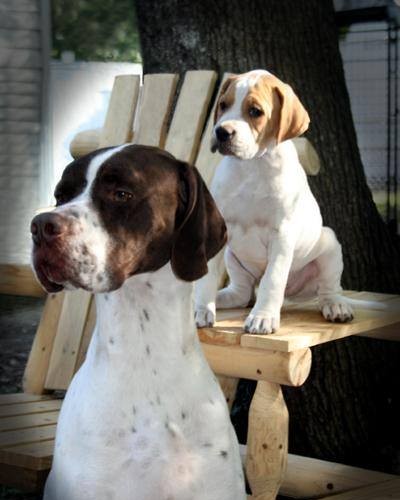
The Pointer is thought to be an ancient breed that was developed in England. The Pointer is unmistakable as a dog that can carry out its job in the field, and conveys both power and speed. The Pointer head is unique with its pronounced stop, cleanly chiseled cheeks, and deep muzzle. The head might be a “dish” style where the nose is slightly higher at the tip than the muzzle at the stop or have parallel planes of the skull and muzzle. The tail tapers to a fine point, and the ideal tail is referred to as a “bee sting” tail that lashes from side to side in harmony with the gait. The coat is short and dense, and can be liver, lemon, black, or orange, either in combination with white or solid-colored. You probably recognize the Pointer “Sensation” from the Westminster Kennel Club logo.
The German Shorthaired Pointer was developed in Germany as an all-purpose utility dog, able to point, retrieve, track, and hunt large and small game as well as game found in heavy cover or water. The breed is square or slightly longer than tall, or otherwise described as “short-backed standing over a lot of ground.” The movement is balanced and “alertly” coordinated, without wasted motion. The head is not a Pointer head; rather, there is a gradual rise to the forehead and an almond eye as opposed to the Pointer’s rounded eye. The short coat feels tough and may be solid liver or solid black, or a combination of liver and white or black and white with either ticking or patches.
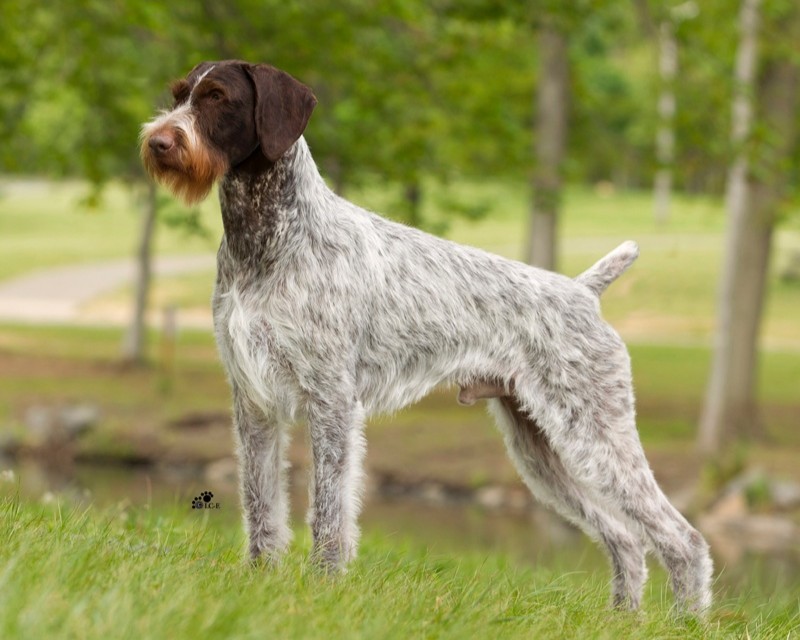
The German Wirehaired Pointer also originated in Germany and was developed by pragmatic people who wanted a rugged, versatile hunting dog that could work in all kinds of terrain and conditions. The goal was to develop a wire-coated dog that would be protected in heavy cover or cold water, and that had the mental fortitude to withstand these conditions as well. The coat is the hallmark of the breed and should be harsh, wiry, and one to two inches long on the body. A double coat is correct in order to protect the dog, but it will be more or less prolific depending on the season. The coat on the skull is short, but there should be a detectable beard and whiskers. The German Wirehaired Pointer is liver and white, and may be spotted with ticking and roaning or solid liver. Unlike the German Shorthaired Pointer, the German Wirehaired Pointer cannot be black. These dogs should be presented naturally, with minimal grooming.
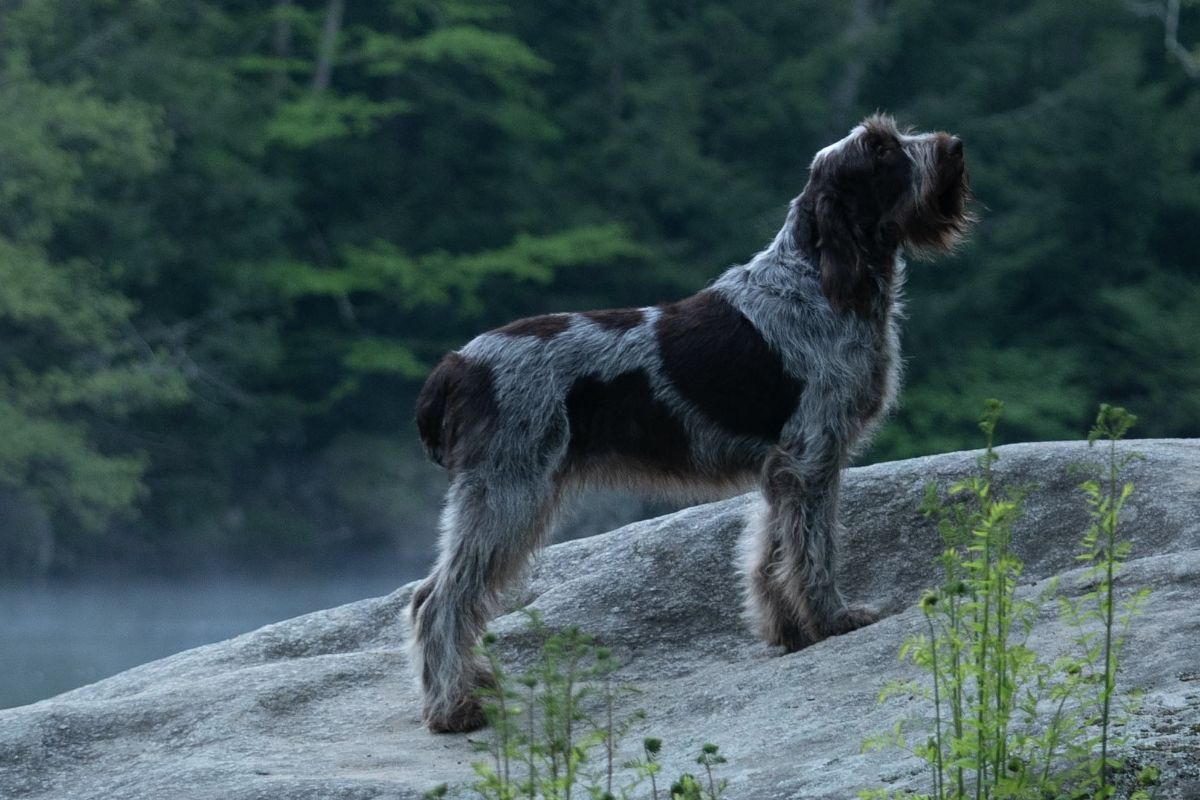
The Spinone Italiano is the other Italian gundog and descends from ancient Italian hunting dogs. This is a robust dog of substance with a distinctive profile. The Spinone is square or nearly square and, like the Bracco Italiano, has a two-piece topline. The long head is of critical importance to breed type, with divergent planes, lean cheeks, and a barely perceptible stop. The Spinone has a soft, human-like expression, which comes from its wideset, almost round, large, expressive eyes that are set frontally on the head. Built for endurance, in the field the Spinone displays an extended trot with intermittent galloping strides. The coat is a harsh, single coat that is longer on the body than the legs and head. Coat color may be solid white, white and orange, orange roan with or without orange markings, white with brown markings, and brown roan with or without brown markings. The skin is equally important and must be thick and impervious, protecting the dog from brush and cold water.
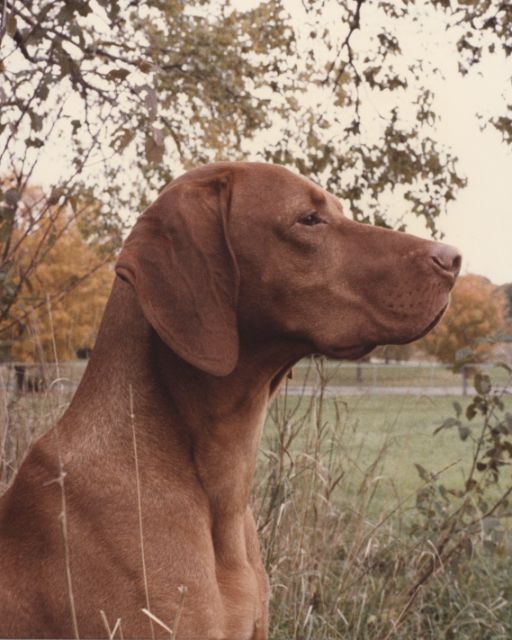
Another continental gundog, the Vizsla is likely the descendant of eighth-century Hungarian hunting dogs. This is a versatile gundog bred to be a gentleman’s hunting dog and family companion. The Vizsla is the second smallest of the pointing breeds and described as “robust” and “lightly built.” The word “moderate” or “moderately” appears in the standard 18 times. The hallmarks of the breed are its unique color and outline. The outline is a series of gentle curves. The Vizsla has a short, dense coat that is varying shades of golden rust. The self-colored nature of this breed means that the color of the iris, all pigment, and toenails are in harmony with the coat color.
The Weimaraner as we know it was developed by the German nobles of Weimar to have exceptional tracking ability, speed, courage, and durability as well as to have their distinctive gray coat. They traditionally were used to hunt large game, but the decline of large game and the introduction of guns led to a heavier emphasis on the Weimaraner’s pointing skills. This is a graceful, alert, aristocratic-looking breed that can be the same height as the Pointer, and thus, among the tallest of the pointing breeds. The coat is short, smooth, and sleek in shades of mouse-gray to silver-gray but never a true brown or blue tone.
The development of today’s Wirehaired Pointing Griffon began in the Netherlands for the purpose of establishing a hardy, all-terrain, close-working hunting dog, working in the marshy, low-lying ground of the Netherlands. The Griffon is a pointer on land as well as a retriever in the water. This is a medium-sized dog that is slightly longer than tall, never square. Most distinctive is its hard, coarse coat that is straight and wiry with a thick undercoat. The Griffon has an abundant mustache and eyebrows that contribute to its charm and friendly expression. The features of the Griffon’s coat contribute to its unkempt appearance. The Griffon is the smallest of the four wirehaired Sporting dogs, but is most often compared to the German Wirehaired Pointer. The Griffon has a square-shaped head in profile, in contrast to the longer, leaner muzzle of the German Wirehaired Pointer. The Griffon is preferably steel gray with brown markings or roan, white and brown. Orange and white is acceptable but much less common. In contrast, the German Wirehaired Pointer is liver and white.
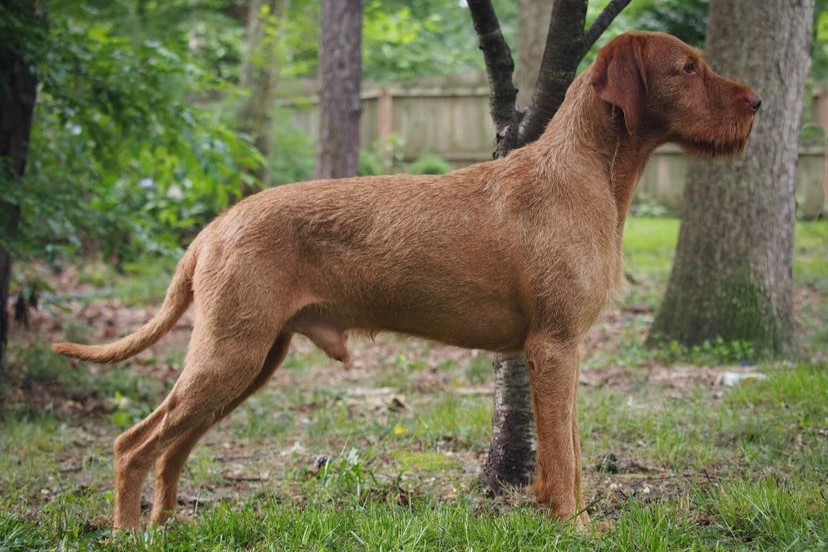
The Wirehaired Vizsla was developed by hunters and falconers in Hungary who desired a sturdy, versatile hunting dog able to withstand harsh winters in the field, forest, and water. This is not a Vizsla with wire hair. The breed is slightly taller and more robust than the smooth-coated Vizsla. The Wirehaired Vizsla’s most distinctive feature is its wire coat and facial furnishings. The coat is approximately one inch long, dense, wiry, with a dense undercoat. The pronounced eyebrows highlight the stop and a harsh beard also enhances the expression. Unique to the Wirehaired Vizsla are its V-shaped brushes in the coat, which are found on both sides of the neck. Like the Vizsla, the Wirehaired Vizsla is self-colored, meaning the iris, the pigment, and toenails all match the coat color, which can be varying shades of golden rust (also like the Vizsla).
The different qualities of the four setters remain, more than 400 years after their development, in response to how they accommodated the terrain over which they were hunted. These are four unique breeds in spite of their similarities and common purpose.
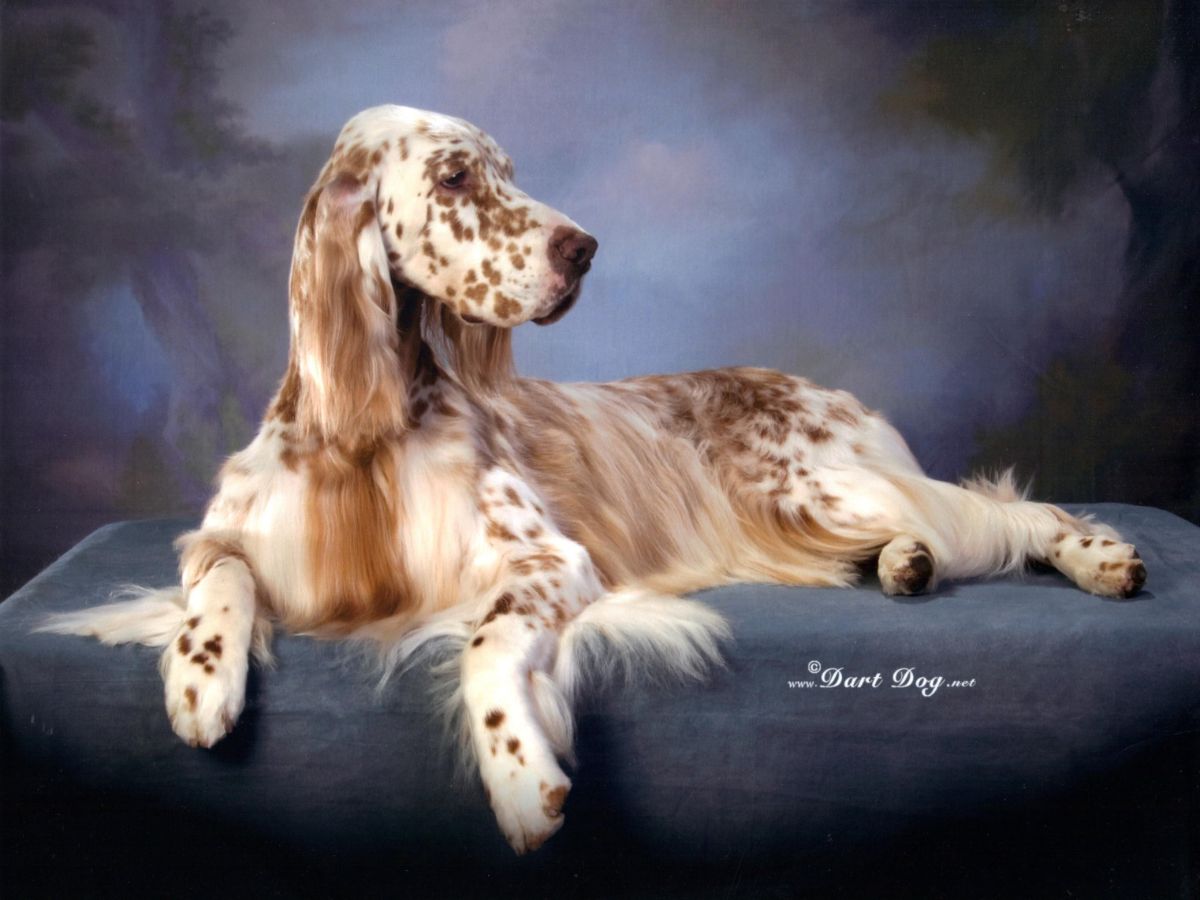
The English Setter was developed in England as a dog with a blend of stamina, strength, and grace. These dogs were bred to navigate the moors and semi-rough terrain of the rolling hills in England. The breed sits between the Gordon and the Irish with regard to the amount of bone it carries. The topline of the English Setter inclines slightly downward without a sharp drop at the croup. All of the setters have heads with parallel planes. The English Setter has a good depth of muzzle with flews squared and fairly pendant. The eye of the English Setter is to be nearly round, which is most similar to the round eye of the Irish Red and White Setter. The coat is flat without curl or wooliness and with feathering on the ears, chest, abdomen, underside of thighs, back of all legs, and on the tail. The English Setter has a white base color with intermingling of darker hairs that results in “belton” markings in orange, blue, and tri color, with liver and lemon also possible but rare.
The Gordon Setter was developed to be a sturdy, heavy-boned dog, the heaviest-boned of the four setters, allowing it to manage the rough ground and undercover of its native Scotland. The Gordon is a square breed with a moderately sloping topline and nearly flat croup. The head is deep rather than broad, with a muzzle covered by a squared-off but not pendulous flews. Unique to the Gordon, the breed may lift its forefeet up slightly when in motion, an accommodation to the harder, higher cover in Scotland. The coat is straight or slightly waved, and is black with tan markings. Those markings may be bright chestnut or mahogany in color.
As recently as 50 years ago, the Irish Kennel Club considered the Irish Red and White Setter and the Irish Setter to be one breed. Both breeds had to navigate the bog-like terrain of Ireland, so they could not be heavy or coarse and instead are fleet of foot. All four setter breeds should have firm toplines in motion; however, the Irish Red and White Setter has a level topline with a slight rounding of the croup downward to the tail set. The tail may be carried level or just below level. The Irish Red and White Setter is strong, powerful, and athletic (not racy) with an aristocratic, intelligent attitude. The head is broad and domed, in contrast to the long, lean head of the Irish Setter. The coat is comprised of feathering that is long, silky, fine hair, which is present on the back of the front and rear legs, the outer ear flap, the flank, the chest, and the throat. In addition, feathering between the toes should not be removed. The Irish Red and White Setter has a white base color with solid red patches or red color, also called “clear islands” of red color.
The Irish Setter is aristocratic, substantial yet elegant in build, with a rollicking personality. The Irish Setter appears slightly longer than tall, carrying a topline that inclines slightly downward without a sharp drop at the croup. Its head is long and lean, in harmony with its body type. Like the Irish Red and White Setter, the Irish Setter should have a clean muzzle, squared off, with lip covering (not the depth of the Gordon or the English when viewed in profile). Like the Gordon Setter, the Irish Setter has an oval eye. The coat and feathering of the Irish Setter are straight and as free from wave or curl as possible. It is trimmed to emphasize the dog’s lean head and clean neck. The Irish Setter is mahogany or rich chestnut red in color.
The similarities across the six retrieving breeds stem directly from their shared purpose: to find and bring back shot game (primarily waterfowl) undamaged, over challenging terrain and water. Each of these breeds features a dense, water-repellent double coat* designed to protect the skin from icy water and harsh cover. They typically possess relatively small ears, appropriate for a water dog. They possess strong, muscular hindquarters for propulsion and structural balance that allows them to carry heavy birds over long distances. They are built to be highly trainable and biddable with intense desire and ability to locate and retrieve fallen birds. While they share a functional foundation, each breed was engineered for a specific geographical region and hunting conditions.
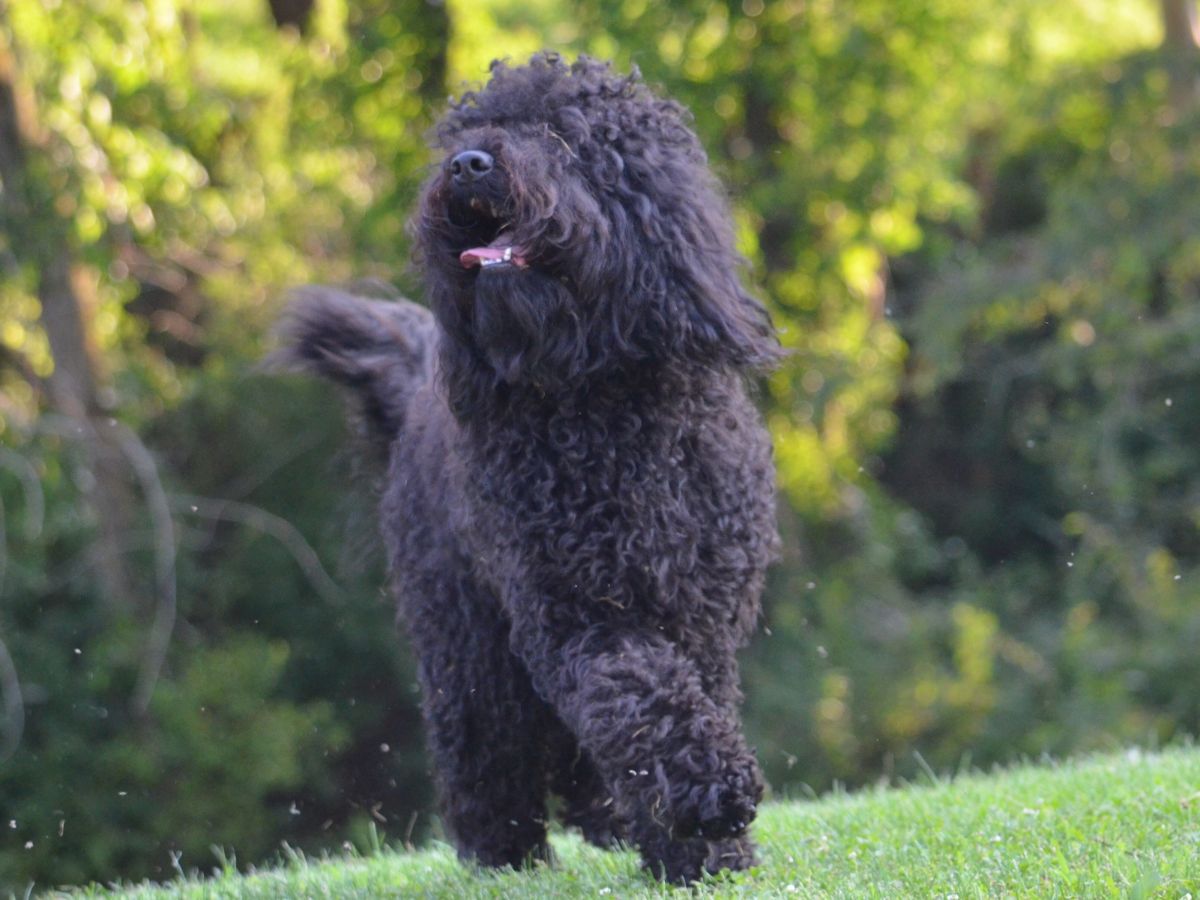
The Barbet is eligible to compete in AKC Retrieving Tests, but it isn’t classified strictly as a retriever. The Barbet is a French water dog that is retriever-like in shape and substance—an agile athlete used primarily to locate, flush, and retrieve birds. The Barbet is known for its dense, profuse covering of curly hair, its big head, and long, sweeping tail. Seeing the Barbet in motion, think balanced, ground-covering, powerful movement. The head is unique in that the muzzle is shorter than the skull and quite square. The Barbet* is not double-coated; however, its coat should be thick and woolly. Any amount of curl is fine as long as there is loft, with the amount of curl ranging from a tight spiral to a loose wave, similar to wavy and curly Portuguese Water Dogs. This is a rustic breed, but the coat on the body continues to grow and so should be trimmed, following the outline of the body. The coat on the head is loose and shaggier, and there is a distinctive beard (“barbe” being the French word for beard). The Barbet comes in all shades of black, gray, brown, or fawn, with or without white markings; or primarily white with any shade of black, gray, brown, or fawn markings.
The Chesapeake Bay Retriever is an American working retriever that was developed along the Chesapeake Bay to hunt waterfowl under the most adverse weather and water conditions. Therefore, the coat is a critical and functional hallmark of the breed. It is thick, oily, coarse, wavy, and short with a dense, fine, woolly undercoat. The hair on the face and legs should be very short and straight with a tendency to wave on the shoulders, neck, back, and loins only. Also unique to the Chesapeake Bay Retriever is that its hindquarters may be as high or slightly higher than the shoulders. The head should have a rounded topskull and small ears, set high. The breed has more leg than a Labrador or a Golden Retriever. In contrast to other retrievers, the Chesapeake has a medium-length hock and hare feet. The eyes are very clear and yellowish or amber in color. The coat color of the Chesapeake Bay Retriever may be brown, sedge (reddish variations), or deadgrass, with preference given to solid colors.
The Curly-Coated Retriever is a sturdy and elegant breed that was developed in Great Britain and prized for its field ability, courage, and perseverance. In motion, the Curly should make one think grace and power with its ground-covering stride. The entire body of the Curly, including the tail, is covered in a thick mass of small, tight, crisp curls, lying close to the skin. This coat is dense enough to protect the dog against the weather, water, and challenging cover. The only places you will find short, smooth, straight coat is on the forehead, face, front of forelegs, and feet. Proportionally, the Curly is slightly off-square and gives the impression of being higher on leg than the other retrievers. The Curly’s unique head is a wedge that is longer than wide, with parallel planes and a shallow, sloping stop. The eyes are almond shaped. The Curly can be either solid black or liver.
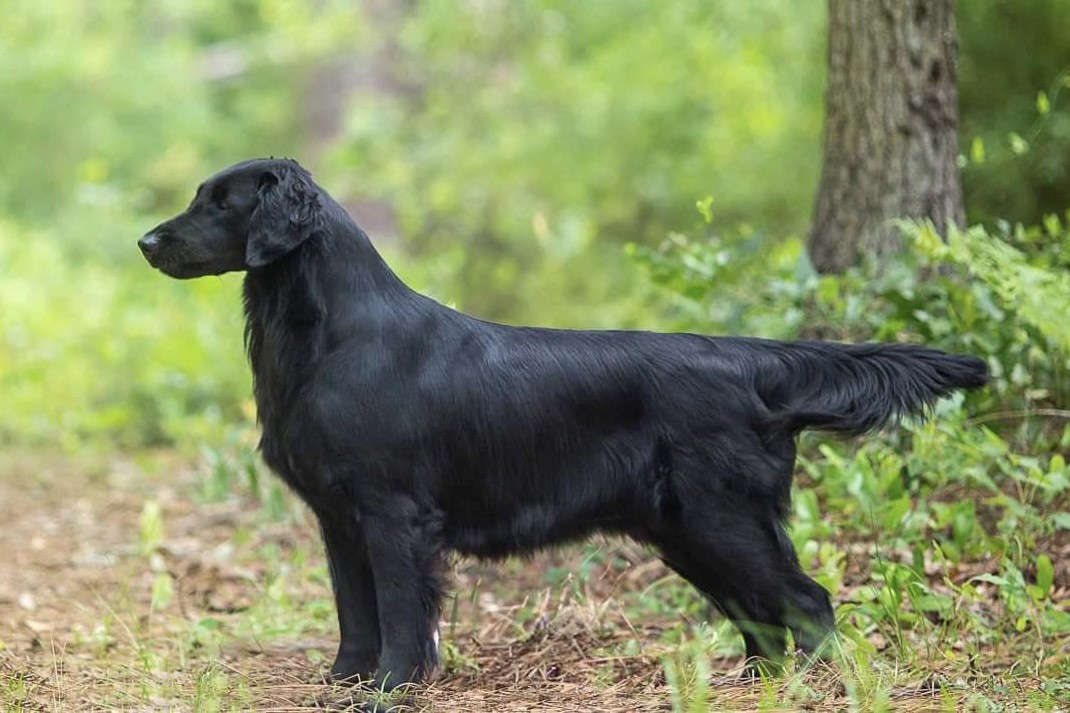
The Flat-Coated Retriever is a cheerful retriever that was developed in Great Britain as the gamekeeper’s dog, optimized for rapid, land-based tracking and water retrieves. This is a rectangular breed that should never appear cobby. The Flat-Coat has a prominent prow and a strong, level topline that continues to a slightly sloping croup. The head is one piece, as if out of a mold, and makes up part of the unique silhouette of this breed. In profile, the head is a slight wedge with flat, clean cheeks and almond-shaped eyes. The coat is straight and flat-lying. The Flat-Coat typically carries a mane of longer, heavier coat on the neck that extends over the withers and shoulders. The coat color is solid black or solid liver. The Flat-Coat* Breed Standard does not require a double coat.
The Golden Retriever first came into existence in Scotland as both a land (rugged terrain of the Scottish Highlands) and water retriever. This popular breed is known for its rich, golden color of various shades and its friendly, reliable temperament. The Golden ought to be only slightly longer than tall (12:11) and hold a strong, level backline that extends to a broad, slightly sloping croup. The Golden’s head should appear somewhat flat on top with a well-defined stop and a muzzle nearly as long as the skull. The eye appears to be slightly almond shaped. The coat should be reminiscent of a jacket, fitting close to the body. It may be straight or wavy but always dense, resilient, and weather- resistant with a dense undercoat. Length or profusion of coat that would interfere with the dog’s function is not correct.
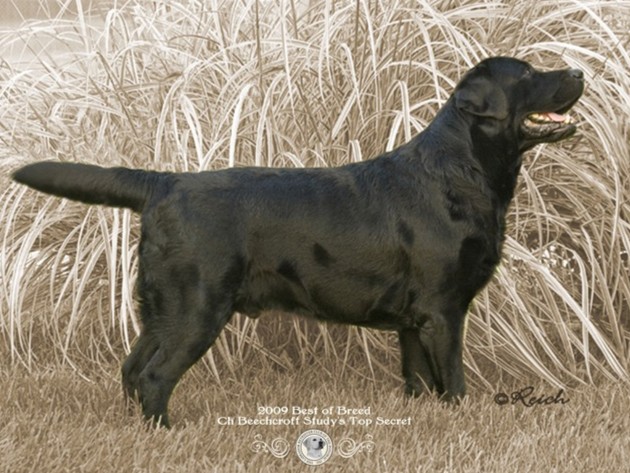
The Labrador Retriever is a water dog that was developed to work with humans. The dogs behind the Labrador are believed to have been brought to England from Newfoundland. This is a rugged breed, built to “cut” water. The coat is a distinguishing characteristic of the breed and is short, dense, and weather resistant. It should feel hard and resemble a tight-fitting jacket, covering a soft, weather-resistant undercoat. The tail is otter-like, very thick at the base and tapering to the tip. It should be wrapped and thickly clothed, serving as the Labrador’s rudder. This popular breed is also known for its eager, tractable temperament. The Labrador is short-coupled with a strong, level topline and almost straight underline. The head is clean-cut with parallel planes and a perceptible brow. The eyes of the Labrador should convey friendliness, intelligence, and alertness. The Labrador may be black, yellow, or chocolate in color.
The Nova Scotia Duck Tolling Retriever, the smallest of the retrievers, was probably brought to Nova Scotia with early European settlers. This is a red decoy dog, bred to toll, lure, and retrieve waterfowl. The playful action of the Toller and its waving tail, like a cunning fox dancing on the shore, are what lures the ducks. The Toller is slightly longer than tall (10:9). The topline is level and the tail should be at least level or higher; the Toller has the highest tailset and carriage of any retriever. In motion, the Toller should convey power with a uniquely springy gait. The head is clean-cut and slightly wedge shaped, with almond-shaped eyes set well apart. The coat is a water-repellent double coat of medium length and softness. The Toller carries a shawl or mane around its neck. Any color of red is acceptable, and the Toller typically carries white on the tip of its tail, its feet, chest, and a blaze, but this is not necessary.
The job of a spaniel is fundamentally different from a retriever or pointer. Rather than waiting for a bird to fall, or pointing at its location, a spaniel’s primary role is to seek out, trail, and actively flush game from dense upland cover within gun range and then retrieve it when called upon. Spaniels typically possess an innate, busy, and quartering ground search pattern—zipping back and forth in a windshield-wiper motion ahead of the hunter to push birds into the air.
Spaniels feature low-set, long, lobular ears covered in varying degrees of feathering. Functionally, these ears act as funnels when the dog’s nose is to the ground, gently sweeping up scent molecules from the grass directly toward the nasal cavity. Spaniels are also characterized by a soft, highly biddable, and merry nature accompanied by an iconic, constantly wagging tail while tracking scent. Since the spaniel breeds have similar parentage, it is important to understand the details that have evolved to make each breed unique.
The American Water Spaniel was developed in Wisconsin to be a versatile, all-around hunting dog, retrieving from skiffs and working on land. Even though this breed competes in AKC Spaniel Tests, it also competes in parent club sponsored Retrieving Tests. Proportionally, the American Water Spaniel is slightly longer than tall, never too square or compact. This is a substantial dog that is solidly built and strong. The tail is unique in that it is curved like a rocker and carries a moderate amount of feathering, as do the legs. This spaniel is thought to carry some of its features, such as its coat and hunting instinct, from the Irish Water Spaniel and the Curly-Coated Retriever. The coat is one of close curls or marcel waves, with a protective undercoat, and may be trimmed or untrimmed; it covers the throat, neck, and rear of the dog. The ear is well covered on both sides and may be shaved. The coat color is solid liver, brown, or dark chocolate.
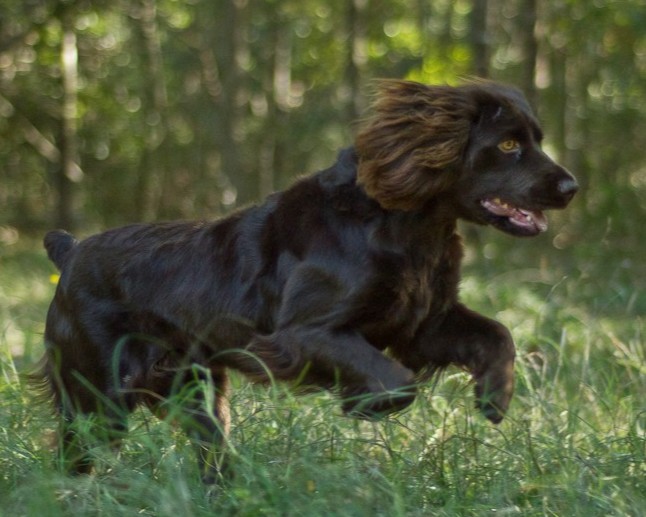
The Boykin Spaniel was developed by hunters in South Carolina to be a turkey hunting dog. The Boykin is similar to the American Water Spaniel, but the two breeds were bred to succeed in very different climates and diverge on some key details, such as the coat. The Boykin is referred to as the “little brown dog that doesn’t rock the boat,” calling out its neat, compact size. The Boykin is also slightly longer than tall. The coat can range from flat to slightly wavy, to curly. The Boykin is typically a single-coat breed, but might have some undercoat. In contrast to the American Water Spaniel’s rocker tail, the Boykin’s tail is docked. This is a wash-and-wear breed, and thus should not be overly groomed, but there is typically some neatening around the head, throat, ears, tail, and feet. The Boykin’s coat is a rich brown color, with all shades of solid liver, brown, or chocolate equally acceptable.
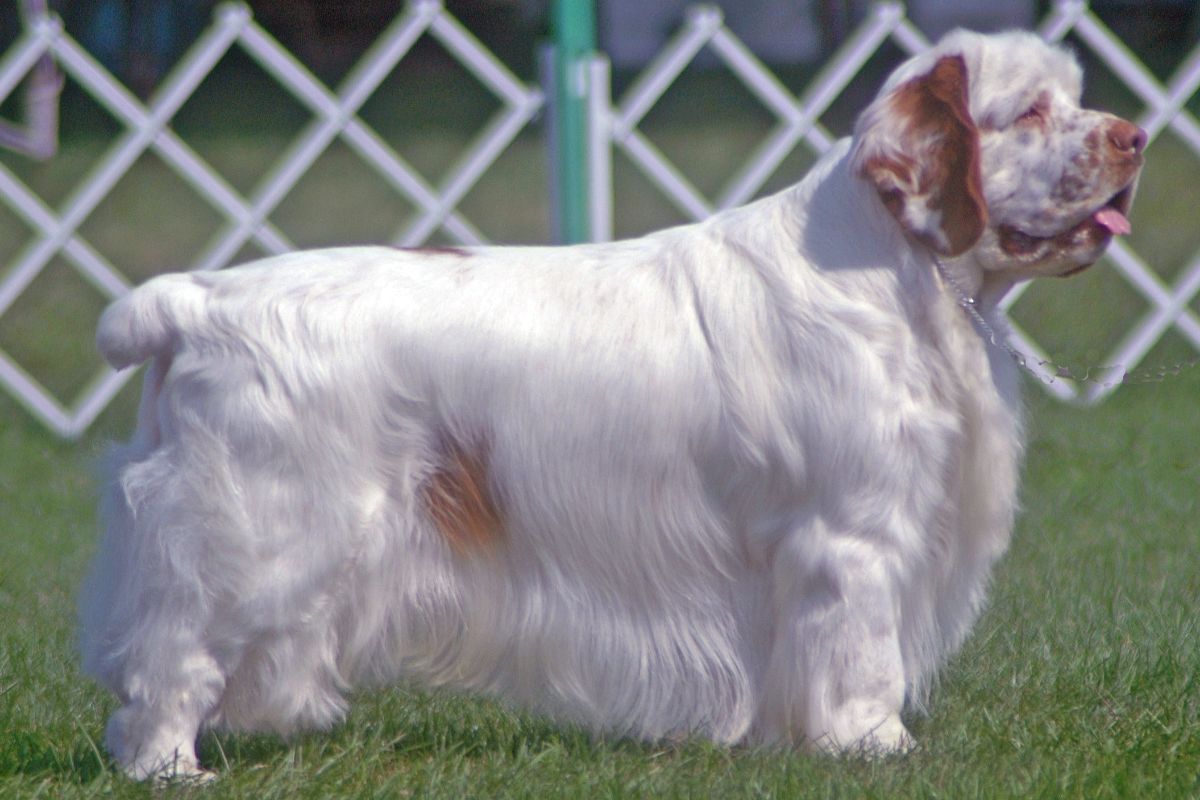
The Clumber Spaniel, the largest of the spaniels, was first recognized as an English breed for the purpose of flushing or “beating” game out of very difficult, dense cover. The Clumber is also a capable retriever, and its large feet and water-resistant coat support this function. The Clumber is remarkable for its massiveness, its large bone, long length of body, and depth of body. Proportionally, the Clumber is rectangular (11:9, when including only the length from the withers to the base of the tail) and carries a powerful back. The Clumber carries a thick, loose, protective skin and a distinctive head. The head is massive with a marked stop; broad, deep muzzle; and heavy brow. In motion, the Clumber rolls due to the breadth of body and short legs. The coat is dense, straight, flat, and weather resistant. The spaniel neck frill is part of its armor when beating through the brush. The color is white with either lemon or orange markings on the head, ears, or base of tail.
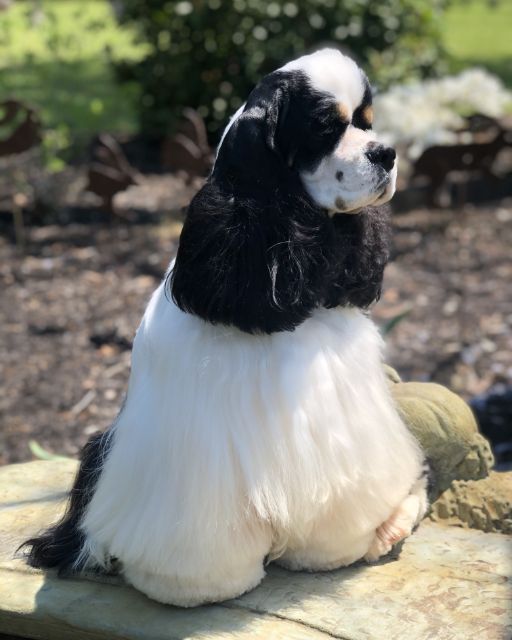
The Cocker Spaniel is the smallest of the Sporting breeds and the fourth of the four American Sporting breeds discussed here. The name comes from the breed’s proficiency in hunting woodcock. The “American” Cocker was officially recognized by the AKC as a breed separate from English Cocker Spaniels in 1946. The Cocker is a merry little dog that should be sturdy and compact with a cleanly chiseled head. Its body is slightly longer than tall and carries a slightly sloping topline. Unique to this spaniel is a tail that is carried in line with the topline, or slightly higher. The Cocker head, with its beautiful, soft expression, is one of the hallmarks of the breed. The skull is rounded with defined brows and a pronounced stop. The muzzle is broad and deep. The eye is round, looking forward, with the eye rim giving a more almond shape to the eye. The texture of the coat is more important than the other coat qualities; it should be silky, flat, or slightly wavy. The Cocker comes in three different varieties, based on color, each one eligible to compete in the Sporting Group: black, ASCOB (any solid color other than black), and parti-color. Tan points or markings are also permissible in specified areas.
The English Cocker Spaniel is a compactly built, sturdy spaniel. In silhouette, the English Cocker is slightly taller than the Cocker and carries a longer, lean, cleanly chiseled head. The “Engie” is a very powerful dog for its size. Unlike the Springer Spaniel, the English Cocker pushes through dense cover rather than leaping over it. Thus, the correct Engie must have deep, well-sprung ribs, a short, broad back, a well-developed forechest, plenty of bone, a short, broad loin, and broad, muscular, “hammy” hindquarters. Measuring from the withers to the tail set, the English Cocker is slightly taller than long. In motion, the Engie conveys power more than speed as well as its merry nature. The English Cocker head is unique, its parts combining to create the soft, melting expression. The coat is flat or slightly wavy and silky in texture. The allowable colors include solid or parti-colored (open-marked, ticked, or roan) in black, liver, or shades of red. Tan markings may be present with black, liver, and parti-color combinations of those colors.
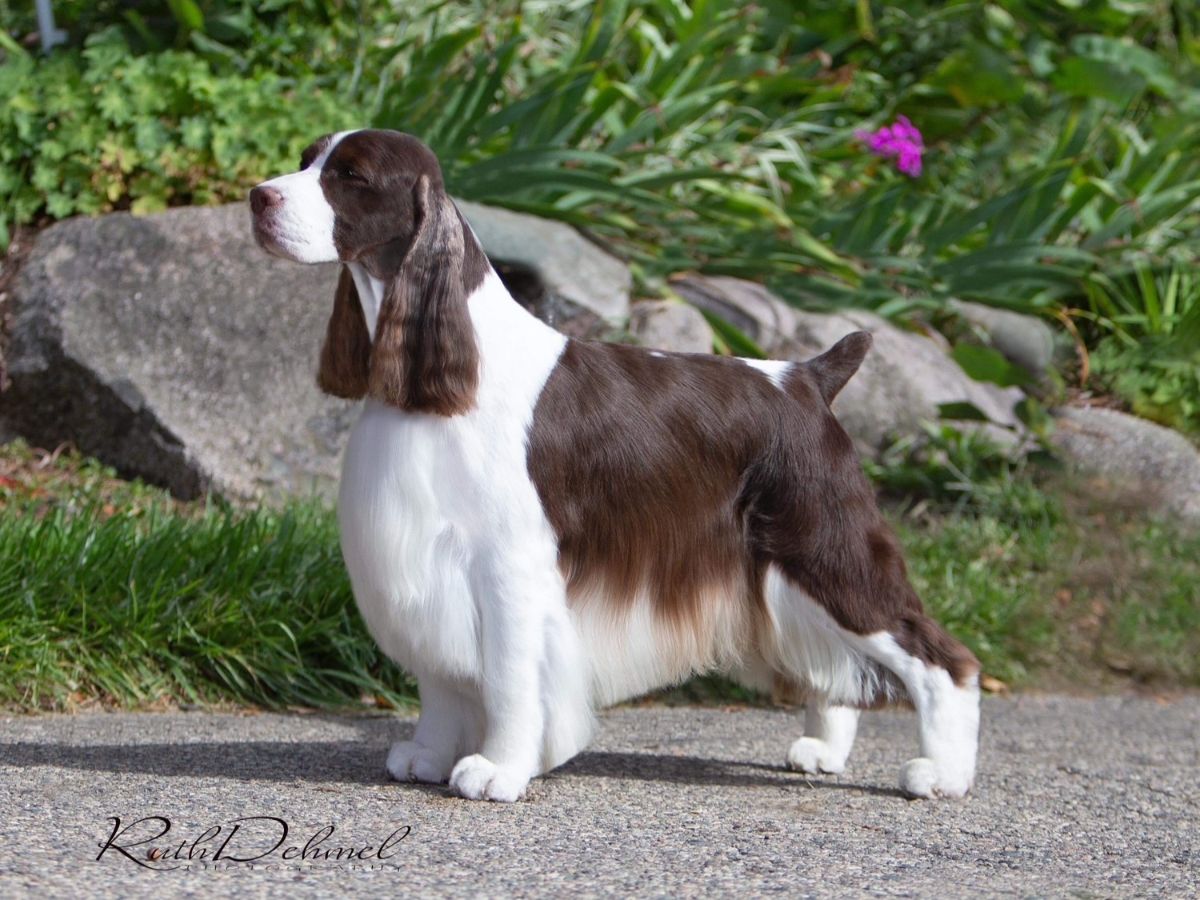
The English Springer Spaniel was once born in the same litter as the spaniels we now call Cocker Spaniels and English Cocker Spaniels (the smaller dogs would be used to hunt woodcock, and the larger dogs would be used to flush or “spring” game). The breed was designed to cover rugged upland terrain at high speed, “springing” game birds into the air for the hunter. The Springer should be thought of as a high-performance athlete in an aesthetically pleasing package; this combination of beauty and utility is what makes the Springer an honored, ancient member of the spaniel family. The head is the essence of the Springer’s appeal. The eyes, a passage into the soul of the Springer, are oval, the color harmonizing with the coat color. The coat is of medium length, flat or wavy, with a short, soft, and dense undercoat; together, the coats serve as protection against the elements and harsh cover. The Springer may be black and white or liver and white; blue or liver roan; or tricolor (black and white or liver and white with tan markings).
The Field Spaniel was also developed in England and was also bred with Cockers until the late 19th century. They were bred with Springers in the 1950s to save the breed from extinction. The Field Spaniel is larger and more substantial than the English Cocker but not as massive as the Clumber. Again, we talk about a substantial, solidly built spaniel that can work in heavy cover and water, where beauty meets utility. The Field Spaniel’s symmetry, gait, and purpose are more important than any single feature. The terms “moderate,” “moderately,” “gentle,” and “slightly” are used often in the Standard to convey this point. Proportionally, this breed is longer than tall (7:6). The Field Spaniel carries a unique head, which is unlike that of other spaniels. It is a long, lean, and clean head with the lowest ear set of any spaniel. The stop is moderate and the head planes are slightly divergent. The eyes are almond shaped with tight lids. In expression, the Field Spaniel may appear noble, serious, and gentle. The coat is single and flat or slightly wavy. The Field Spaniel may be black, liver, golden liver, (or shades thereof, in any intensity), or bi-colored, and may carry tan points.
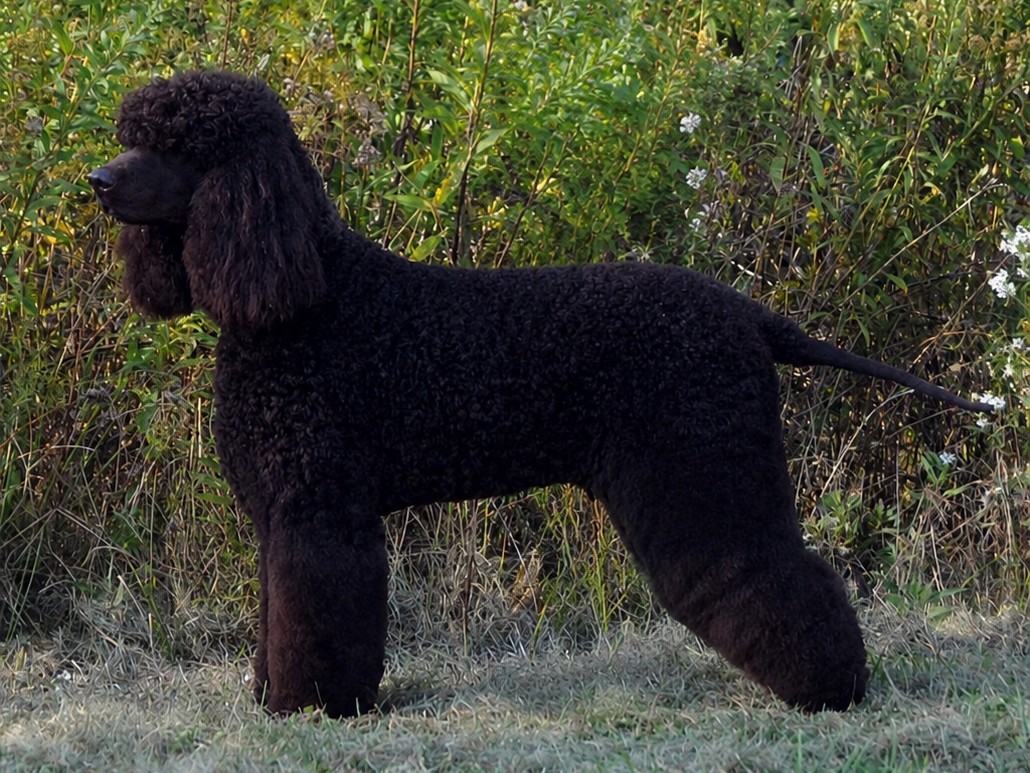
The Irish Water Spaniel is a relatively old breed of dog that was bred to hunt in severe bogs as well as the extreme cold of the North Sea. The breed is commonly seen in AKC Retriever Tests as well as Spaniel Tests. The head pays homage to its retriever and spaniel heritage; it is cleanly chiseled with a squared-off muzzle and carries an almond-shaped eye. This spaniel appears slightly rectangular. The distinguishing features of the breed are its topknot of long, loose curls (covering a well-defined peak between the eyes); a body covered with a dense, crisply curled, liver-colored coat; a smooth face; and a smooth “rat” tail. The liver color is a rich liver to dark liver with a purplish tinge, sometimes called puce liver.
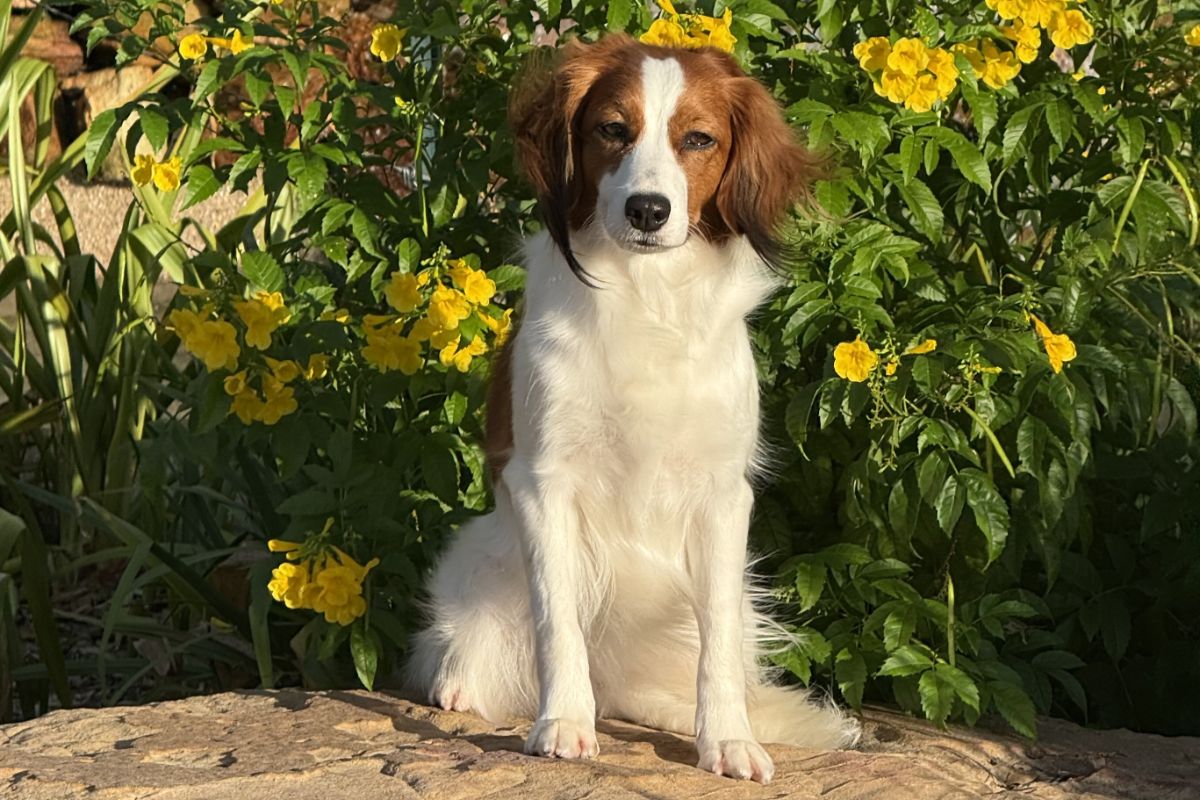
The Nederlandse Kooikerhondje was developed in the Netherlands as a tolling or decoy dog and works similar to the Nova Scotia Duck Tolling Retriever by attracting ducks from the shore and drawing them into nets or, in the case of the Kooiker, eendenkooi (duck traps). They are the only Sporting dog that works in front of game. While not technically a spaniel, they are “spaniel-like” and became eligible for Spaniel Hunt Tests in 2021. This is a harmoniously built, orange-red parti-colored small dog with almost square proportions. The tail and ears are hallmarks of the breed. The black hair tips or long black featherings, also called earrings, are highly desirable but not imperative. The tail is well feathered with a white plume to attract waterfowl, waving when animated or moving. The coat is close lying and can be slightly wavy but not open or curly. The orange-red color is ideally displayed in distinct patches on a pure white background, with a white blaze on the head that extends to the nose.
The Sussex Spaniel gets its name from Sussex, England, where the breed was developed to handle the clay soil, dense underbrush, and thick hedgerows. This is a long, low, rectangular, level (topline), and relatively massive breed used to burrow through the dense cover and flush game. The body is tubular, with the well-sprung ribs carried well back to a muscular loin. The head of the Sussex is a unique feature; its somber, serious appearance with fairly heavy brows and a clearly defined stop produce a frowning expression, in spite of its friendly demeanor. In motion, the Sussex resembles the Clumber in that its short legs and long body produce a rolling gait. The coat is abundant, flat, or slightly waved. The neck carries a well-defined frill. The color of the Sussex is always golden liver.
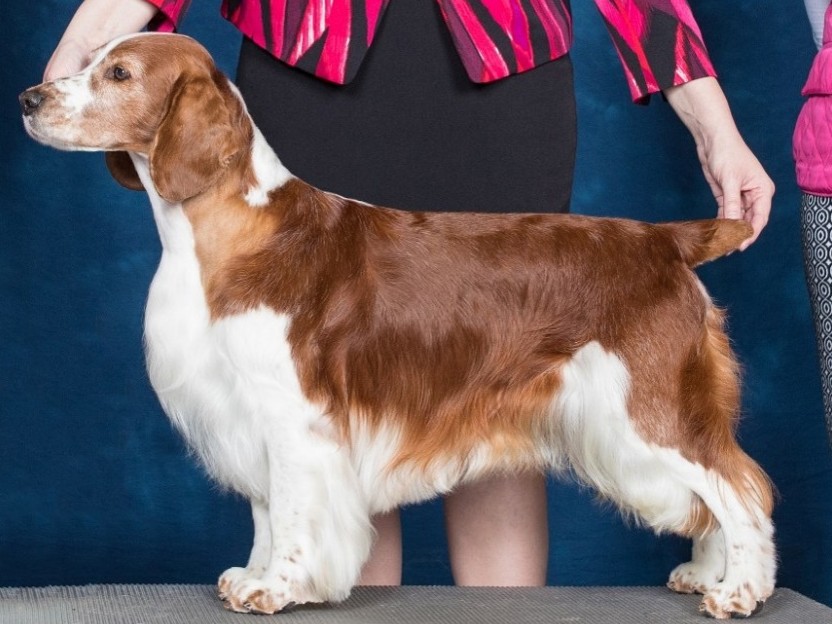
The Welsh Springer Spaniel is recognized to have existed in the United Kingdom as a strain of red and white spaniels for several centuries before its recognition as a separate breed. This is a functional, unexaggerated dog that is sturdy enough to go into or under heavy cover to find and flush game. The Welsh is a compact breed with a rectangular silhouette (body length never shorter than the height). The Welsh Springer’s head is unique, slightly domed, possessing a clearly defined stop, well chiseled below the eyes, with slightly divergent planes. When viewed from above, the entire head is slightly wedge shaped and has a soft wedge shape when viewed in profile. The eye is oval with tight eye rims. The ear is relatively small for a spaniel and shaped somewhat like a vine leaf with light feathering. The coat is straight, flat, and soft to the touch with enough density to be protective. The color is only a rich red and white, in any pattern.
The Lagotto Romagnolo was originally an Italian duck retriever, but when the native marshes dried up, the breed was repurposed as a truffle hunter. The dense curly coat of woolly texture is one of the most distinctive breed characteristics and contributes to the breed’s rustic appearance. The head is another hallmark of the breed. Like the Barbet, the muzzle is shorter than the skull. This is a square breed with a compact, strong body and a strong, short loin to facilitate its purpose as a truffle hunter. Think of a broad, blunted wedge (the head), over a square. The body of the Lagotto is covered in tight, ring-shaped curls, not frizzy hair. The coat is woolly and semi-rough with visible undercoat. The coat on the head of the Lagotto is longer with looser curls, abundant eyebrows, and a beard. The Lagotto may be solid off-white, white with brown or orange patches, brown roan, orange roan, brown, orange, or sable (with or without white). Tan markings are acceptable.
Thank you to SHOWSIGHT for the opportunity to showcase the 33 breeds in the Sporting Group. Of course, each description is incomplete and attempts mainly to capture the unique essence of each breed as well as what makes these dogs similar and different. I have loved spending my life with Sporting dogs, and having the chance to get to know them all through judging has been a gift.

American Kennel Club (AKC)
Betsy Yates reflects on judging the National Owner-Handled Series Sporting Group at the 2025 AKC National Championship.