Members
Doug Johnson shares how teamwork, mentorship and shared knowledge help breeders grow, improve quality, and find success in the dog show world.

The Weekly Brief
The best of SHOWSIGHT editorials, weekly wins, and breeder commentary — delivered to your inbox every Sunday morning.
We don’t get to where we are in the sport of purebred dogs on our own. Participation is a group concept where, hopefully, we knowingly or unknowingly all inspire other people and are inspired by others as well. This is true, of course, in many phases of our lives. There’s more power in a mass collective thought than with the individual who does everything on their own. If we can work across the board as a group, it’s to everyone’s advantage—and the breeds are the ultimate beneficiary.
Each generation in the sport learns from the four previous generations: the architects of the sport; the students of the founders who were taught how to do things according to their plan; the people who would develop the breeds to participate in the competition; and the followers within those breeds who continue to breed them, some successfully, some not. As we progress, we learn through trial and error, and we eliminate the errors by concentrating on the successes that others have had before us. Knowledge is passed down from one generation to the next by iteration. Today, I know there is a willingness to learn. Now more than ever, there are people who want to know how others have achieved a higher level of success in dogs. They want to know how they can be equally successful. There is a craving for knowledge and for quality. People want better and they are willing to try harder to get it. They don’t want to waste their time failing. After all, we all know that it is more rewarding to win than to lose.
Unfortunately, there can be an intimidation factor in the sport that creates a distance and a disconnect between the novice and the successful breeder and exhibitor. This roadblock presents a challenge. What the novice person does not usually understand is that the successful person wants to share, but they can be protective of their success. They can be guarded. Novices don’t always understand that successful people in the sport are reserved and guarded because they are protective of their position. They are appreciative of their success, and they don’t want to risk it. Their success is part of their status, and they know that it’s harder to fall from the top. Sadly, many of the successful have some battle wounds that prove this.
I always find it fascinating when people refer to me as intimidating. I’m not that at all! I am told that people are uncomfortable approaching me, unfortunately. I know that I can be direct and I do call a spade a spade, but for those who willingly come to me for advice or opinion, they generally benefit from the positive interaction. I put on breeding seminars and write these columns for this very reason. I put information out there and am receptive to the feedback and inquiry—and even some of the scrutiny. And many times, in previous writings, I have said, “If you have a question, email me.” I’m happy to hear from you. This is part of a contribution I can do for the sport that has been so generous to me.
No matter how you participate in the sport, it is essential to surround yourself with a culture of like-minded people who want to move forward with positive thoughts, who are building a team of like-minded individuals with the same purpose and who are supportive. And many times, you’re looking for someone who is more talented (or at least equally talented) and you learn by watching. When you go to the dog show, if you set up alone in the back, you’re not privy to what’s going on in the tack area in the front. And so, maybe, just by location, you’re doing yourself a disservice by not watching the professionals and the long-term breeders. Try moving your tack area closer to a breeder who’s been around a long time, or someone who you have seen in the winner’s circle often. Learn from their vantage point. Find out what they do in their setup that translates to success in the ring. Then work to apply that to your own situation.
I remember watching Carolyn and Merle Taylor. They had a beautiful van and beautiful crates, and they were always at the dog show early. I always tried to set up near them because, just by osmosis, I was absorbing things from them. Carolyn used her watering can for carting water to the x-pens to fill up her water buckets, instead of lugging a giant container of water. I thought that was so clever and such a simple thing to do. I learned by watching that there are easier ways for getting things done that are doable for anyone. For example, how do you set up a big x-pen and a small x-pen together? There’s a method to making it stable, and you learn that stability by watching other people who have done it for years. By simply watching the more experienced exhibitors, they become part of your team.
A team, however, doesn’t always have to be local. With today’s technology, team members can even be an ocean away. I find it can be a lot easier to work with someone outside my country, especially in a breed as small as mine. It’s easier to work over an ocean because there isn’t the competition. Admittedly, there is an inherent selfishness in breeding, where people can have a hard time sharing. They have a hard time sharing the joy and they have a hard time sharing the success. Individuals can get bruised and battered when there’s an “I” mentality rather than a “we” mentality. I understand this, but I don’t like it. For me, I don’t need a trophy. I don’t need a ribbon. I am really interested in quality and in the acknowledgement of the teamwork required to pursue that level of quality. The ribbons will come when someone else appreciates your vision and approves or acknowledges the effort you took to create the image you’ve designed. That’s important. I like to win and it is important to be competitive, but I’m happy to share the ribbons with someone who wants to come along and experience the joy and the heartbreak, and also the great highs that come from being a passenger on the ride. The great breeder Carol Harris of Bo-Bett Farm used to say, “Remember, it’s more fun to win!”
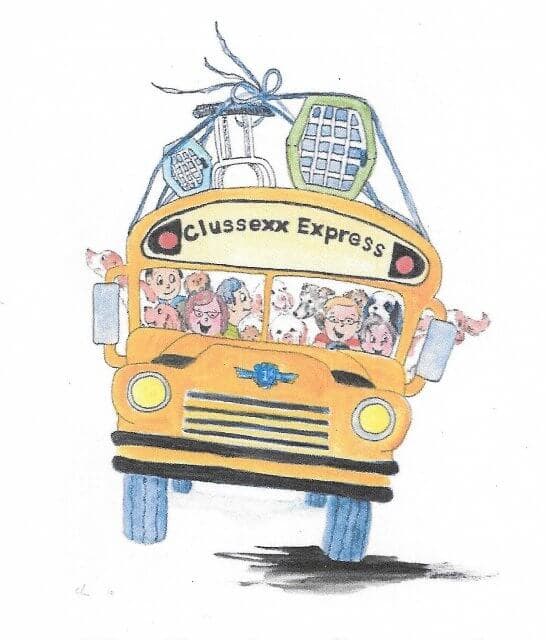
Years ago, I printed up a little notecard of people on my “bus,” which represents my kennel. On the card, members of my team are all riding the same bus, but someone’s in charge of the driving and navigating. The navigator is in charge of determining the path, but the navigator will accept instructions from the backseat drivers. Do we all turn here? Do we breed to this dog? Should we incorporate a new person on the bus? These are all committee decisions. The bus has a lot more strength when there’s a team onboard, and bingo, the bus has more resources because they’re shared among the riders. By contrast, the person who wants to do it all themselves is driving a Mini Cooper.
Now is the right time for opening a dialog and creating a place for learning, where people can expand their team and make improvements from wherever they are. For me and my team, this has been the year for stepping up and making more effort, but 2026 is the year to inspire that effort for better; to acknowledge that we need to focus on quality above all else. So, let’s all take this time to make a plan to seek out knowledge from someone who has walked before us, who has experienced the heartbreak and the joys that come with breeding quality dogs. And most importantly, let’s learn from them. Look to those four previous generations and ask, “Who is in the generation or two above me that can provide me with a little light at the end of the tunnel so that I can start walking towards something better, something greater?”
Dog Show Community