Members
A powerful look at Ukraine’s hero dogs, honoring service teams, volunteers, and the life-changing role dogs play during wartime.
The Weekly Brief
The best of SHOWSIGHT editorials, weekly wins, and breeder commentary — delivered to your inbox every Sunday morning.
Kyiv is a big city, and during the day it doesn’t look any different than any other big city elsewhere in the world, including modern towering skyscrapers. During the day, people are shopping in one of the many ultra-modern shopping centers, and during Christmastime it was pretty crowded. In the evening, those malls are open late, but when the electricity is cut, big generators take care so that you can hardly see any difference except for the streetlights, lifts, and elevators that are not working. I visited a Christmas fair, including a Ferris wheel working thanks to big generators. The people have apps on their phones to check which hours electricity is available, and another app that gives an indication if there is a risk of bombings. Big shelters are everywhere. Later in the evening, the streets become desolate and spooky; not a car, not a person, not even a cat can be seen in the streets.
With no direct flights because of the war, the only option for me to reach Kyiv was traveling by train. One option was to go via Warsaw where there is a train to Chelm, a small town near the border of Ukraine. This trip lasts almost three hours. From here, you step over to a Ukrainian sleeping train for another 11 hours. The border control easily takes between two and three hours. From what I could see, Ukrainian men have to provide a lot of paperwork to show they have permission to leave the country and are not fleeing the war. From my place in Belgium, it took me 26 hours to reach Kyiv, including a lot of waiting for connections.
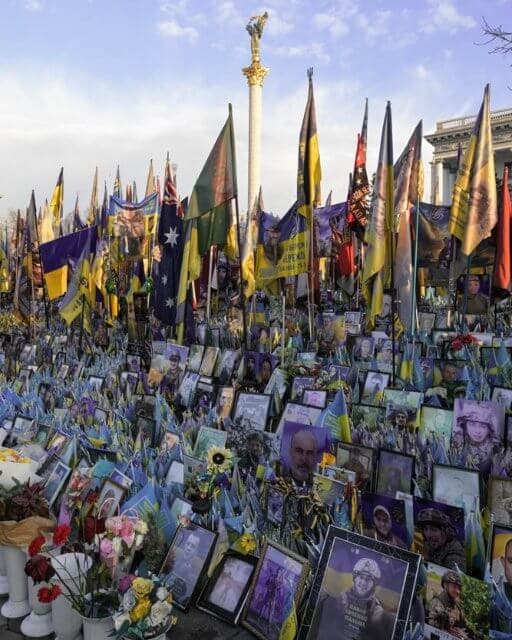
I stayed in the Ukraine Hotel facing the famous Majdan Square, where the Orange Revolution started, and several years later, the violent protests took place against the corrupt and Russian-influenced regime. Now, a part of it is completely covered by Ukrainian flags, one for each soldier who died in the current war. In front of St. Michael’s Cathedral is another square, filled with tanks, trucks, bombs, and drones of all kinds, destroyed and burned out.
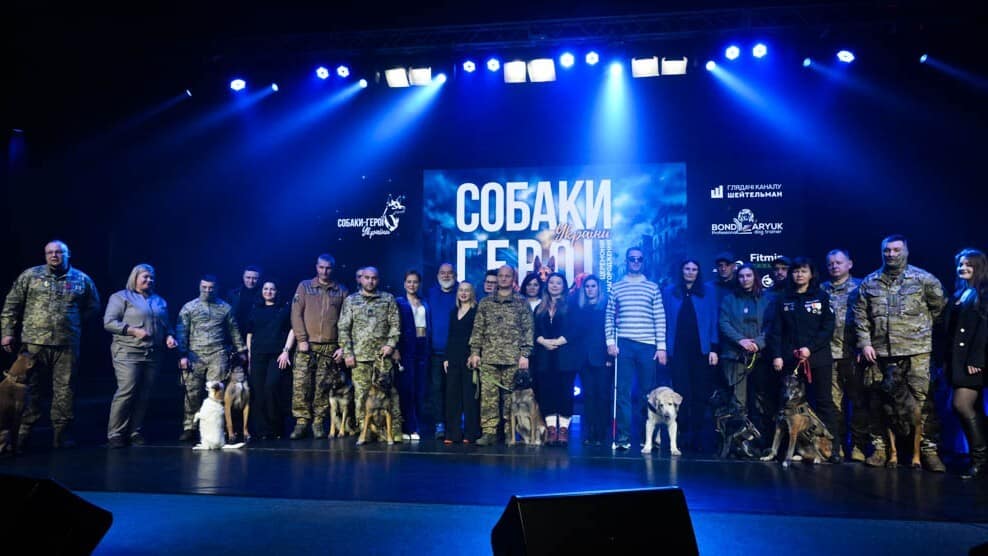
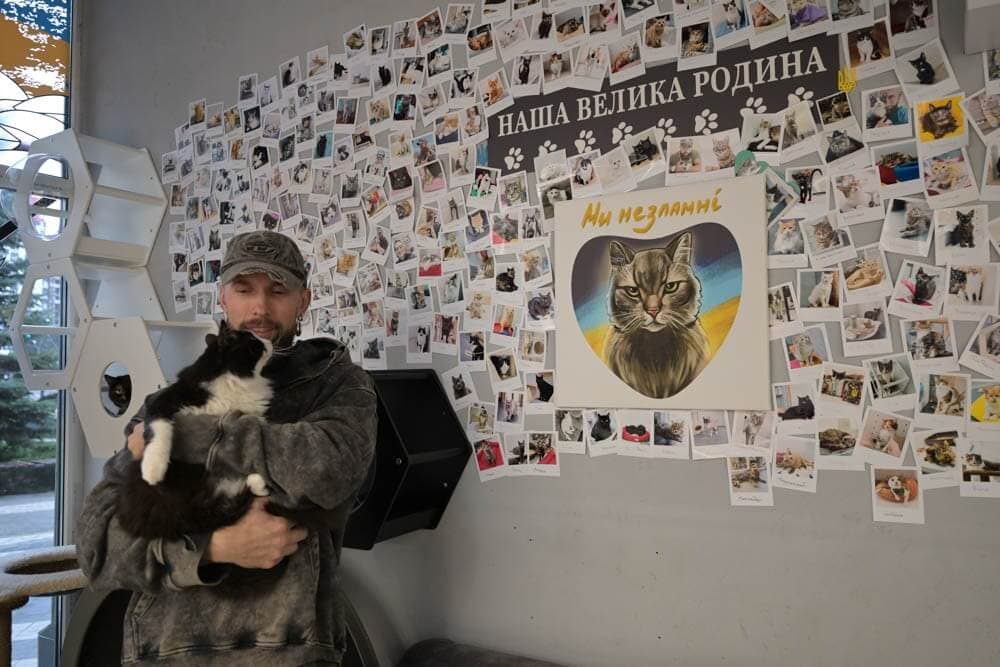
The purpose of my visit was the “Dogs-Heroes of Ukraine” celebration. In a small hall, outside the city center, 12 dog teams involved with all kinds of army and police tasks were celebrated alongside 15 teams of volunteers for their significant contribution to the welfare of soldiers, dog owners, and the country in general. It was clear the army welcomed the help of civilians who professionally trained their dogs to find victims, dead and alive, or were trained to find explosives. These civil organizations work closely with the army and often stay with them near the frontline. Their value has been highly appreciated and recognized since the start of the war. They work in shifts along with the soldiers and enjoy a similar support from the government. The volunteers were more involved in the evacuation of dogs in the war zones, often left behind when their masters had to flee for their lives. Food, medication, and shelters for these dogs were very important. Everything had to be done in such a hurry that owners often could not find a solution for their dog, and in some cases left their dog behind. It was also very difficult to buy food, as electronic payment was no longer available without electricity. Many benefactors wanted to be sure their goods were not sold to warehouses but arrived directly at the shelters. It was thanks to the volunteers that many dogs were rescued and even returned to their owners if they could find them. DOG HELP KHARKIV UA (see Facebook or Instagram) is one of those shelters that was also awarded. With the help of Frederik Guttormsen, a person from Norway who provided the money, the volunteers could buy a property and change it into a modern shelter. Oleksiy Surovtsev, a national celebrity and actor, also started a shelter for cats and dogs and evacuated a lot of them himself. Near Butcha, he transformed a pet shop into a shelter for the cats. He usually has around 50 cats. When he started, he also had lots of dogs, but over time the number of dogs decreased to 15 on average. Many of his four-legged guests were wounded, shot, or burned. Oleksiy showed me some horrible photos of injured animals while the result of his good care was sitting on his shoulder. And they all adore him, begging for his attention. His shelter is very modern, with heating, a surgery room, and a quarantine room.
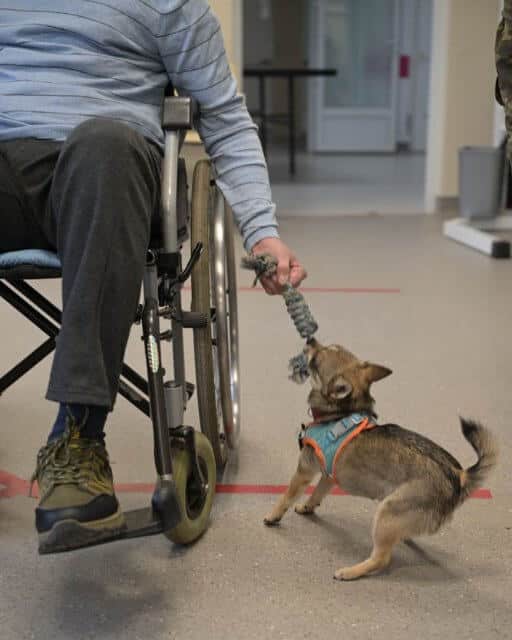
It is often forgotten how many ways dogs serve man. On Monday, we were invited to the military hospital where we met Kateryna Bieliaieva. She developed a rehabilitation program for wounded soldiers with the help of some of her dogs. It was really amazing to see how all the patients were beaming with pleasure to see her coming with her dogs. Immediately, the dogs were going around to the patients to be cuddled and get treats. A Chihuahua that she adopted from a soldier who died in the war was obviously the boss over the two Malinois. She also had a Nova Scotia-like street dog that she found with a broken spine that recovered after a surgical procedure of nine hours. This dog is popular among the soldiers and has already made more than 700 visits to the center. Later, the dog became the first official mongrel police dog in Ukraine.
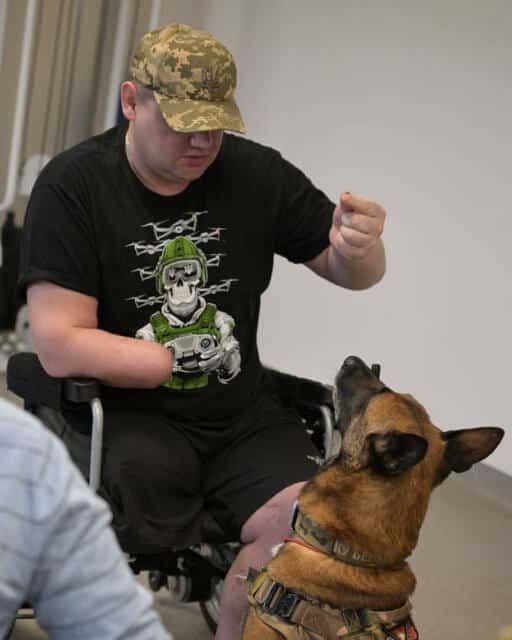
Kateryna developed a series of coordination exercises for the soldiers, and it looked like she achieved spectacular results. It was clear how much the soldiers liked working with her dogs and she received full support from the medical team. Even the well-trained Chihuahua does a great job and loves to work with them. I was exceptionally moved by how a soldier who showed spastic behavior, probably due to brain damage, and who sat apathetically in his wheelchair, was asked to move his arm up little by little and give a treat for one of the Malinois. But from the moment he felt the nose of the dog trying to get the treat, a slight smile appeared on his face. These are moments you never forget. No doubt that the dogs have a different impact on these men, offering comfort and also a new perspective towards life after all they have suffered. Many start training dogs themselves, as we could see when we visited the dog training center of the National Police in Kyiv Region.
The old center was very near Bucha, the town renowned for the massacre that the Russian army committed against the local civilians in the first weeks of the war. It was destroyed, as it was situated right between both armies. Only one dog was killed, though some were injured, and all the rest could be saved and were working again shortly after the incident. Not long after that, Mr. Howard Buffett, the son of Warren Buffett and a dog-person/trainer himself, showed special interest in what happened to the center. After a visit, he decided to finance a completely new training center. Everything one could imagine was provided: a surgical operating room, an RX room, a revalidating room, a kitchen, a shelter complete with heating, air purifier, water recuperation, a stock room, and a fitness corner. Upstairs are not only the rooms of the residents, but the top floor even has hotel rooms where visitors from other departments can stay. Outside are two long rows with dog kennels, all with floor heating. Alongside them is an open-air training facility, and if the weather conditions are not good, there is another one that is protected. Mr. Buffett also offered eight trucks with cabins for four dogs, all with air-conditioning, and he also twice financed 10 dogs trained for explosives. It is with pride that the Head of the center, Mr. Maksym Pishchansky, showed me the huge painting of Mr. Buffett’s first dog, “Bolek,” on the outside wall and the specially designed logo, a dog paw, half with the American flag and the other half with the Ukrainian flag.
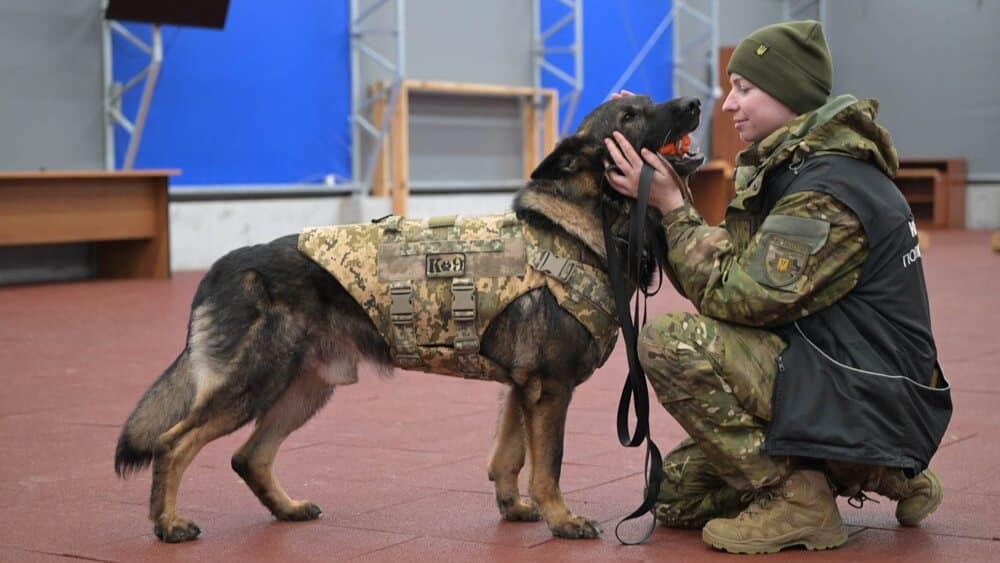
The center has its own breeding program based on artificial insemination, and the bitches are followed up via echography. All the equipment is on site. One vet is permanently linked to the center, while two other specialized vets assist when required. While this is a police department, the connection with the army is very close and many war invalids are working here. Ukraine has approximately 1,000 service dogs, with 55 in Kyiv, including SWAT teams. Every trainer has a minimum of two dogs, one for tracking and another for special skills. The dogs are trained for different tasks like searching for victims, dead or alive, all kinds of drugs, protection, etc. Explosive dogs are trained to detect four different kinds of explosives. One of the trainers, Olena Petrolai, was the first female officer to be awarded with “Knight in the Order of Courage” by President Zelenski himself, for clearing the road full of victims with her dog for safe passage while she was wounded herself.
A war puts a different emphasis and creates a special kind of solidarity. I met many heroes in a couple of days. Before leaving, many people said I was courageous to go to Ukraine, but no, this is nothing compared to what all these people do every day. And what moves me most is that many of them feel the importance of pets, and dogs in particular, taking care of them as a team.
I want to thank Yuliya Strizhkina for inviting me and compiling an interesting program, and for being my interpreter. And I also want to thank Katerina Mumzhinska and her husband, Yura, for spending four days with me, showing me around, driving me to our appointments, taking photos, advising, and entertaining me. Without them, this trip would never have been possible.

Meet the Junior Handlers