Members
Learn what sets the Hound Group apart as Denise Flaim examines the history, structure, and purpose behind these remarkable breeds.

Denise Flaim
The Weekly Brief
The best of SHOWSIGHT editorials, weekly wins, and breeder commentary — delivered to your inbox every Sunday morning.
Photos provided by author.
Things are often not as straightforward as they seem, and dogs are no different.
Take the Hound Group—please. That bursting-at-the-seams assemblage—33 breeds and counting, with the Peruvian Inca Orchid set to arrive the first of next year—isn’t as simple as just Sighthounds and Scenthounds. Indeed, in FCI jurisdictions, the AKC Hound Group splinters into no fewer than four Groups, from primitive types to earthdogs, and everything in between.
No matter what classification system you use, it does help to think of the Hounds—and, indeed, all breeds—as members of various families. Some groupings are more obvious than others, some created more by similarity than shared blood. But in finding the connecting threads between breeds, those unexpected associations deepen your understanding as a judge, breeder, and forward-thinking fancier.
Let’s start with the aerodynamic Sighthounds, though there is some disagreement among purists about precisely which breeds warrant the label. I used to be a big-tent advocate—and then I became more educated about morphology, and what it means to be a true coursing hound. From a Bedouin point of view, many of our Sighthound breeds as we define them are based on crosses. As my Arab mentor once asked me of the feathered Saluki: “Have you ever seen a dog with furnishings in the Sahara?”
So, like the Facebook status says: It’s complicated.
 Ch. Shirkhan of Grandeur, the dog Anne Rogers Clark carried in her mind’s eye as the ideal Afghan Hound.
Sighthounds can be further divided into their Afro-Asian and European sub-families, whose differing terrains and purpose directly affect their form.
Every Group has its breeds of connoisseurship, and among the Hounds most would agree the Afghan Hound is one of them. Some of our most influential fanciers, then and now, came from this aristocratic breed, smitten by its exoticism—hip bones so prominent you could cut yourself, dramatic saddle, flowing coat, and distinctively lofty gait. Immensely popular in the 1970s thanks to its hippie aesthetic, today the breed is sharply reduced in quantity, though quality dogs are still very much to be found.
As with all coated breeds, the Afghan Hound runs the risk of seducing the onlooker without taking into account what is under all that hair. Reaching in and feeling an actual prosternum and capacious ribbing rather than an exoskeleton—that’s the real turn-on.
 A flashback from the 1990s, Saluki Ch. Gemini Phaeton Jane Eyre.
The Azawakh and Sloughi, two newcomers to the Sighthounds in this Group, are frequently misunderstood. Unlike the Afghan Hound, which has a conga line of exemplars for students to look back on (Shirkhan, anyone?), these desert hounds are exhibited in far smaller numbers. In the case of the Azawakh, I benefitted from a close friendship with the famous Italian kennel Azamour, where studying dozens of dogs from multiple families taught me the irrefutable geometry of the breed: You can’t achieve the desired silhouette without an appreciably long upper arm. As you might suspect, both breeds are quite closely related and similar in overall structure, with the fineness and elongation of the Azawakh setting it apart from the comparatively heavier-boned, broader-headed Sloughi.
I can’t leave these three breeds without sounding a note of frustration about how many new fanciers do not understand the very basic, non-negotiable fundamentals of gallopers made for the desert. First, they have low withers, never above the level of the hips. This—and not their rear angulation—is what creates their distinctive, airy gaits. And the withers are formed by bone, not vigorous exercise. (Stop laughing—I heard that professed at an actual seminar. The only thing more unbelievable is that not one judge in attendance raised a hand to question it.) And second, a powerful, muscular, compact loin is essential. As McDowell Lyon taught us, the loin is the keystone of the dog; like that architectural element, it is a fundamental point of union, transmitting rear drive to the front assembly. If it is long, lax, weak—pick your derogation—it compromises a Sighthound’s core function beyond belief. This used to go without saying, but now, apparently, we need to say it—louder and more often.
The Saluki poses a frustrating challenge to judges, as its Breed Standard comprises a whopping 320 words, second only to the 225-word Greyhound Standard in terms of brevity. It is also the only true Sighthound that has a trotting function, which means its withers can reasonably be higher stationed than the other desert hounds.
Through study and mentorship, judges must ultimately choose a direction, a philosophy, an aesthetic to pursue in this breed. (My mentors were of the English school, with Daxlore and Burydown as their guidestar; your mileage may vary.) The Standard’s acute brevity invites this divergence of styles: square, taller than long, longer than tall—all are equally acceptable. If you’ll pardon the pun, the Saluki tent is a very big one, because the dogs have been bred since antiquity in different game-dependent sizes. And don’t forget to lift the flap for the smooths: They were the original model.
 Ch. Vigow of Romanoff, bred by Mr. Borzoi himself, Louis Murr.
Now let’s turn to the European Sighthounds, or, more accurately, those of the British Isles. Because they hunted lusher terrain, their conformation differs from their desert brethren. Most have elongated but powerful and well-arched loins, which impart tremendous speed. Unlike the desert Sighthounds, in which length of loin is the typical challenge, with their Western cousins it is placement that bedevils. Too many have their rise placed too far forward, over the back instead of the loin, which robs the latter of its power and the former of its flexibility.
For the Greyhound, the famous description from a 15th-Century poem is the optimal starting point: “…headed like a Snake / And necked like a Drake / Footed like a Cat / Tailed like a Rat / Sided like a Team / Chined like a Bream.”
“Chine” is a medieval term for the spine, especially of an animal, which in the freshwater bream is quite high backed; this deftly describes the curvy topline, made so by the arched loin. “Sided like a team” refers to the draft horse, which is deep chested—a requirement in any true Sighthound, for which heart and lung room are non-negotiable. Coupled with the other poetic metaphors—a narrow head, long neck, functional foot, and fine tail—we are given the portrait of a peerless courser, built for speed and style.
The British obsession with social class permeates even their dogs. The Whippet was considered the “poor man’s Greyhound,” incorporating terrier blood (have a look at the Bedlington to understand the cross-currents at play here) to create a lively, attractive companion that could run in miners’ rag races as well as provide food for the pot. While brindle particolors are so popular as to have become a cliché, good judges know top quality can be found in the solid blacks, blues, and creams as well. As with the Greyhound, S curves above and below are the coin of the realm here.
The Scottish Deerhound and Irish Wolfhound both invoke the Greyhound in their Standards, but in subtly different ways. The Deerhound Standard describes its type as “a rough-coated Greyhound of larger size and bone,” implying a regional version and using the word “Greyhound” no fewer than six times. The highland modifications of that formula—wiry coat and lilting gait included—are well suited to the misty, scrub-covered moors of Scotland.
By comparison, the Wolfhound has far greater mass and clear Mastiff influence (via the Great Dane blood that was used to revive the breed after it went extinct alongside the Irish wolf centuries ago). As a result, its Standard tellingly calls it “Greyhound-like” (emphasis mine), implying a greater degree of separation. Years ago, I mentioned to a well-respected Wolfhound breeder and judge that the curviest Wolfhounds were often slightly short on leg, while those well up on leg were often a bit boxier. Her resulting shrug provided confirmation, but no actionable answer.
Borzoi occupy a fascinating middle ground in this Sighthound split: Like the country that produced them, they are both European and Asian, refined in appearance and ruthless on the hunt. To my mind, they retain the fineness of the desert hounds with the overall conformation of the European variants. To the latter point, not feeling for the rise over the loin will earn you the dreaded checkmark on an observation by an AKC Rep, and deservedly so: That long, silky coat can hide a multitude of sins, including a too forward-set rise.
Borzoi arguably have the most delicate head type of all the Sighthounds, in that it can easily be ruined by too heavy a brow or too much fill, resulting in a Roman head.
(For decades, the Borzoi was the only Hound breed whose Standard requested full dentition and so mandated checking the sides. But in recent years, the Azawakh, Sloughi, and Basset Fauve de Bretagne were added to the list, with the coated Peruvian Inca Orchid coming in January. With every other breed in this Group, a front check suffices.)
 Crufts and World Show-winning Multi-Ch. Rhodesian Ridgeback Just Like A Dream Of Luanda. photo courtesy Milada Krchnava
I remember how my dear friend, the late Bo Bengtson, agonized over whether or not to admit the Rhodesian Ridgeback and the Basenji into the pages of his hugely influential Sighthound Review magazine, which I later edited and published. He eventually relented, taking comfort in the idea that both are Sighthound influenced, which of course is true.
That said, the two are frustratingly difficult to precisely classify. I often describe the Ridgeback—much of whose Standard, tellingly, was lifted word for word from that of the Dalmatian—as a Goldilocks breed: It exists in a constant state of tension between opposing forces—speed and power, elegance and strength, galloping and trotting, the Sighthound and the Working dog. Like that blond interloper and her fairy-tale bears, the most satisfying choice lies not in either extreme, but in the middle ground. I like my porridge just right, too.
As for the Basenji, no one, not even the geneticists, has deciphered its origins. “They might be cats,” a genetics researcher once told me, only half-jokingly. The slightly hooded ears, tightly curled tail, foreshortened muzzle, and diffident temperament hint at a primitive Asian origin, but, regardless, today we look for a short-backed, lightly built hunter whose poise and elegance evoke a thoroughbred.
The Basenji Standard reminds that the breed hunts by scent as well as sight in its native jungles of The Congo. That multisensorial advantage extends to the several lithe, prick-eared hounds of the Mediterranean, which excelled in hunting over rocky, unforgiving terrain.
Though the Pharaoh Hound’s name evokes the Egyptian dog-god Anubis, which it so closely resembles, its origins on the island of Malta are far more recent. Hunting at night, often in tandem with ferrets, the Pharaoh has generous ears, which reflect the importance of sound in following its prey. My loin obsession resurfaces here as the exception that proves the rule: The Pharaoh Hound’s loin, while quite strong, is longer and more trapezoidal in shape, uniting with a rib cage that is a slightly flattened oval. This unusual though not unique body shape (one also sees it in the Xolo, raising interesting theories about just who colonized South America) has been exacerbated by a spate of long and low dogs, a trend that in recent years has thankfully begun to recede.
On Spain’s Balearic Islands on the opposite side of the Mediterranean Sea, the Ibizan Hound hunts on a similarly difficult terrain. Elegant and deer-like, they spot rabbits by leaping into the air, harnessing sight along with scent and smell to find them among the chunks of limestone and scrub brush. The Ibizan’s high-stepping gait is a critical hallmark, though its mechanics are worth studying closely to make sure it is not confused with hackneying, which is energy wasting and incorrect for this breed.
Heading on to yet another Mediterranean island, we find the Cirneco dell’Etna of Sicily. (The plural is Cirnechi, the last syllable pronounced like “key.”) It too hails from a similarly lunar-like landscape—this time, the lava-rock outskirts of Mount Etna. I’ve watched these dogs in the field—on rabbits nested in a pile of old logs on a New Jersey golf course, but, hey, you take what you can get—and their drive is impressive, to say the least. Though it’s tempting to think of them as Pharaohs that have been left in the dryer too long, there are important differences between these two red-coated Tesem-type breeds, the Cirneco’s high-set, parallel ears and shorter loin being just two of them.
The Portuguese Podengo Pequeno is the final breed before we leave this family of multisensory, prick-eared hounds, which all result from centuries of Moorish influence. (And which, by the way, still exist in North Africa: I’ve seen modern-day photographs of Tesem-type dogs in Algeria that could easily walk into the ring—and win—as wire-haired Ibizan Hounds.)
As the Pequeno’s name suggests, there is more than one size of Portuguese Podengo, though currently only this smallest variety is AKC recognized. (FCI recognizes one breed, with three sizes. Presumably, since it recognized the Pequeno first, AKC couldn’t go this route. So instead it has put both Medio and Grande varieties—the latter of which is now extremely rare—under the banner of the Portuguese Podengo, currently in the Miscellaneous Class.)
The Pequeno is markedly different from these other podengo breeds—and even its other two varieties—starting with its outline. While all the others are up on leg, the Pequeno is 20 percent longer than tall, a proportion augmented by its generous prosternum. That length of body and front fill remind me of another family of canines from similar Mediterranean regions and islands, the bichons, but that’s just conjecture, of which I have plenty.
All this talk of prosternum provides a convenient transition to the Dachshund. Your hands should show what the priorities are: a prominent prow, which should be felt, especially in the Longhaired and Wirehaired varieties, where hair can be primped to mimic bone and flesh; the keel—that is, the underside of the sternum, which should extend well back behind the elbow, to protect the internal organs from protruding rocks and roots when the dog is underground; and, finally, the tail, which should be felt, from root to tip, to ensure no kinks are present. (Many judges skip that final step: Exhibitors tell me they can count those who do on one hand, and have fingers left over.)
While the natural emphasis in the Dachshund is on the forequarters and body—where, again, the length should come from ribbing—rears aren’t to be overlooked. Weak running gear, complete with overlong hocks that contribute to tummy-tapping, can be forgiven to a point. But I draw the line when the dog stops and immediately sits—not because he wants to, but because he has to.
The basics of this German earthdog—long, low, and level, with a wrap-around front—are easily transferrable to the Basset Hound, which is obviously larger and fleshier. In this breed, I pay particular attention to prosternum (sometimes I get nothing but a palm full of wrinkle), matched front feet (one shouldn’t be turned out at an alarming angle), and correct length of upper arm that allows the elbow to be placed below the withers.
The Petit Basset Griffon Vendéen and Grand Basset Griffon Vendéen are differentiated by more than the first words of their respective names. As with all closely related breeds, details matter tremendously. The larger Grand is said to be the more aristocratic of these two French Scenthounds, while the smaller Petit is the countrified cousin. One can see this in their head proportions: The GBGV has a longer muzzle than skull, length and narrowness being associated with nobility; the PBGV, by contrast, has a slightly shorter muzzle, as foreshortened features tend toward rusticity.
Despite being the more rustic of the two, the Petit should never be short-legged.
The newcomer to the Hound Group, the Basset Fauve de Bretagne is the shortest backed of all the bassets, which derives from the French word for “low.” It is quickly gathering the attention of fanciers, who appreciate its sturdiness and outgoing temperament. There is a size disqualification, and for good reason: I’ve seen the breed in countries where stringent DQs are not applied, and they can amass height in an eyeblink.
I think of the Bloodhound as the poster child for the Scenthounds, as its Standard says quite clearly it possesses “in a most marked degree, every point and characteristic of those dogs which hunt together by scent.” That includes its thin and loose skin, long and deep foreface, and extremely long ears. No foot, no hound, the saying goes, and a functional foot is important in this breed, which struggles with a degree of laxity there.
We think of otters as cute, water-loving busybodies that add comic relief at SeaWorld. But in centuries past, they were considered a source of luxurious fur, as well as pests that threatened fish populations. Neither perception ended well for the otters: The Otterhound was developed in the Middle Ages to hunt them, its rough outer coat and oily undercoat providing protection against icy waters. These days, however, its melodious bay is more likely to be heard in the ring than on a riverbank.
It’s helpful to consider the next four breeds in tandem, as they are variations on a theme.
Let’s start with the English Foxhound, whose Standard, Richard Reynolds has told me, was written in haste on the back of an envelope in a bar. Perhaps that well-lubricated environment explains a number of unusual phrases in the document. No one has yet explained to my satisfaction the meaning of “The couples must be wide, even to raggedness.” Pour me another.
An equal mystery to my mind is why the English Foxhound must have a perfectly straight pastern, which is more inclined to break down than a slightly sloped one. (“Straight as a fence post,” I can hear Richard say, with perhaps a colorful adjective thrown in for emphasis.) The best explanation I’ve heard so far is that this is intended to slow the hounds, sort of a conformational hobble, as the whole point of the fox hunt is the journey—and the survival of the fox to be hunted another day.
The Harrier Standard describes it as an “English Foxhound in miniature,” and so it is, from its straight pasterns (which can even knuckle over slightly, such is that maddeningly inexplicable desire for a straight pastern) to its sturdy build. The challenge I find with Harriers is there can be too much of a good thing, leaving a judge to wonder if they are just an English Foxhound that skipped its vitamins once too often.
While pasterns are top of mind, let’s go to the American Foxhound, which, unlike its English counterpart, should have a bend of pastern. That’s an inheritance from the Sighthound-influenced French hounds that were crossed with English Foxhounds to create the breed. Their coursing blood also bequeathed the American Foxhound its distinctive topline, which has a slight arch over the loin.
I fault American Foxhounds with straight pasterns, but I’ve also learned my lesson when judging them outdoors: Cold temperatures make any dog tense up, and that can affect this important angle, especially when the dog is hand-stacked. Make sure you see the dog relaxed before drawing any conclusions.
The Beagle, regardless of variety—under 13 inches or between 13 and 15—has two tough demands to satisfy. First it must be a sporting little hound, merry in action and leaving no doubt of its ability or will to chase down any cottontail unfortunate enough to make its encounter. But it must also have an expression so soft, so plush, so pleading, that it’s worth staring at after a long day’s hunt. All in a sound, sturdy package.
A word about color is warranted before we leave the Beagle: Tri-color is not the only pattern to be awarded. There are some excellent lemons and blues that lose simply because judges don’t find their coloration striking—or familiar—enough.
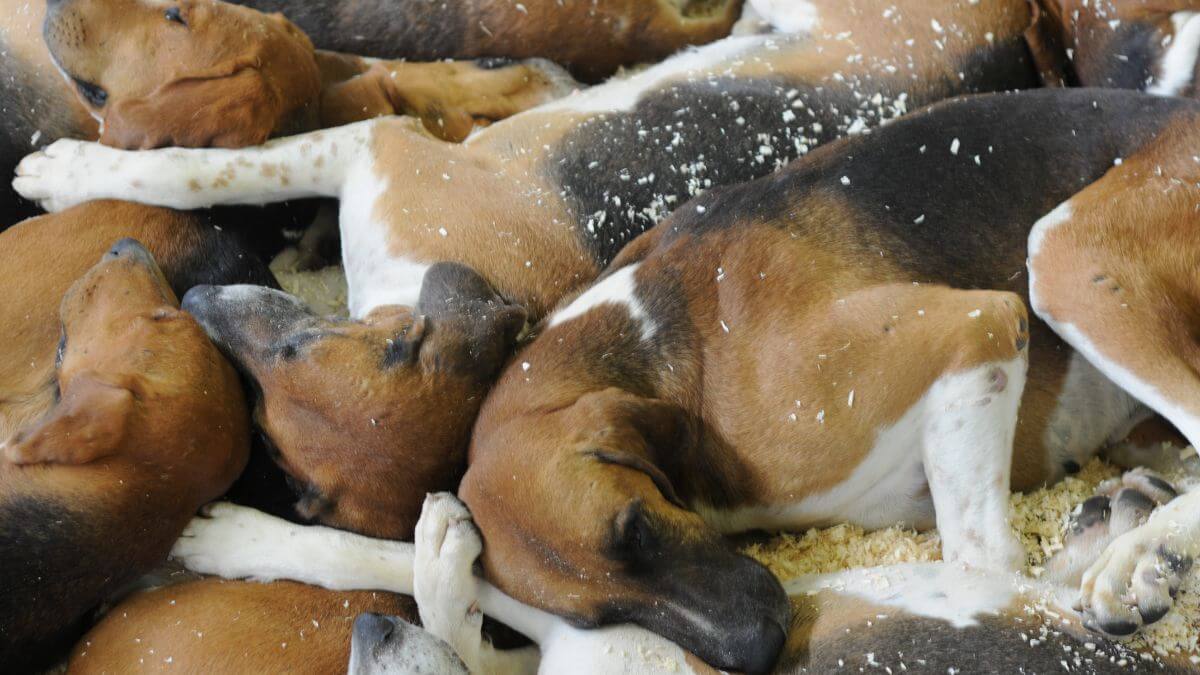
 Poitevin hounds sleeping at the World Dog Show in Paris in 2011. photo by Dan Sayers
The Coonhounds form a closely knit Southern family, comprising breeds often separated by seemingly translucent degrees. With the exception of the Plott, the Coonhounds are basically Foxhounds crossed with French hounds. They are differentiated by their colors and patterns, as well as their bone and substance.
(Notice a theme here? All these French hounds being crossed three ways to Sunday to create America’s native scenthounds? George Washington was, after all, a founding father of the American Foxhound breed, too. The historical fact is that the French had—and still have—a ridiculously large number of native Scenthounds, most of which have Sighthound behind them, like the vaguely Borzoi-looking Poitevin pictured above. Unlike the British—whose more publicly exposed packs and hunts resulted in shared breeding stock among the aristocracy, and a generalized “type” developing over large distances—the French breeding scene was much more insular, leading to seemingly every chateau developing its own strain. This was a boon for American importers, who had their choice of quality, linebred hounds that were still actively working game. The aforementioned Poitevin was bred to hunt wolf by a marquis until he—the marquis, not the wolf—lost his head in the French Revolution.
Returning to the Coonhounds—finally!—the Bluetick Coonhound is one of the heaviest of the bunch, as it was required to follow cold trails, and so had to work more slowly to tease out the older scent. The Bluetick’s pigment isn’t blue: It’s just that the admixture of white and black hairs gives the illusion of that coat color.
At the other end of the scenting spectrum is the Treeing Walker Coonhound, which is justifiably famous for its “hot” nose. Though these hounds can be white with tan or black spots, the preferred pattern is tri-color—which sometimes leads to them being confused with American and English Foxhounds. In fact, Treeing Walker type can be thought of as a middle ground between the two. A critical component that set breed type was crossing a stolen deer-hunting dog known as “Tennessee Lead” into a Walker pack back in the 1800s. Presumably a good dog if someone went to the trouble of nabbing it.
The common ancestor of both the Bluetick and the Walker is the somewhat racier-bodied American English Coonhound, which comes in a variety of colors and patterns, including tri-color, which must have a degree of ticking. Never refer to the breed by its “official” name, as no one who is knowledgeable calls them that, even if the American Kennel Club insists on doing so. Refer to them as “English dogs” instead—a reflection of the fact that their earliest stock came from English-imported foxhounds. You’re welcome in advance.
As its name suggests, the Black and Tan Coonhound is identifiable by the distinctive color pattern in its name. But several other traits make it stand apart from the previously mentioned, more closely related coonhounds, including its greater bone, substance and overall scope, and spectacularly long ears, which are believed to have been contributed by the addition of Bloodhound along the way.
The Redbone Coonhound is distinguished, as its name also announces, by its rich red color, which is said to have been brought over with the foxhounds of Scottish immigrants in the late 1700s. That red can vary from golden fox to mahogany, but should never get so muddy as to appear chocolate. As you’d except of a hunting hound with a cold nose, the Redbone should be well boned but still agile.
 GCh. Black Monday, the first-BIS Plott.
The Plott—that’s it, just Plott, no adding “Hound”—is as free of superfluousness as its name suggests. This is the only coonhound that is genetically separate from the rest, imported as it was by a family of German hunters. Where the other coonhounds have soft, pleading expressions that derive from their long, low-set ears and liquid eyes, the Plott has a sadder expression and less ear length—the most cur-like of the coon hunters.
Last but never least is the Norwegian Elkhound. Years ago, during the ill-fated debate over realigning and expanding the AKC Groups, the talk was that the Elkhound would move to the proposed Working-Northern Group. Indeed, much like the Ridgeback and Basenji, the Elkhound has no comrades in kind among the Hounds. It is unequivocally a spitz, from its prick ears to its tightly curled tail.
Despite its name, the Elkhound’s prey is the moose, and it requires a supernaturally short loin (never mind a hand’s length—we’re talking mere fingers) and correspondingly long legs in order to have the agility to bay one.
Since the Peruvian Inca Orchid is heading into the Hound Group in about six months, that hairless South American breed is worth a preview.
In our classification system, we get twitchy about breeds that are too similar occupying the same Group. And, indeed, there are numerous points of intersection between the Xolo, which currently resides in Non-Sporting, and the PIO. (It’s not an Incan—they’re long gone, but for their pyramids. And it’s not an Orchid—that’s a flower. So go with either Peruvian or PIO.)
One of the major differences between the two is the shape of the rib cage. The Xolo has a more flattened oval shape, like the Pharaoh Hound, while the Peruvian’s thorax is more circular, with a resultingly square body profile. This deep ribbing, arched loin, and noticeable tuck-up are among the reasons the Peruvian Inca Orchid Club of the United States wanted it to be classified as a Sighthound—or at least a breed that in part resembles that group of consummate runners, even if does hail from the mountains. Like the Xolo, the PIO too has a coated variety and three sizes based on weight (large, medium, and small, just like a T-shirt).
And there you have the AKC Hound Group. A pretty diverse bunch, with a few tightly related families throughout. Long legs and short ones, smooth and wire coats, and everything in between, it’s a Group that instructs as much by the differences between breeds as it does by their similarities.
Especially for history buffs, many of our hound breeds fascinate because they harken back to earliest remembered history, from the wire-haired griffon types of medieval France to the original, smooth-coated courser of the Middle East, which in our system is fragmented between the Saluki, Sloughi, and Azawakh. On our own continent, the foxhounds and coonhounds tell the story of our emerging nation, as its diverse geography and populations dictated a need for different dogs across different settlements.
A lot more complicated than just Sighthound and Scenthound—and way more interesting.

American Kennel Club (AKC)
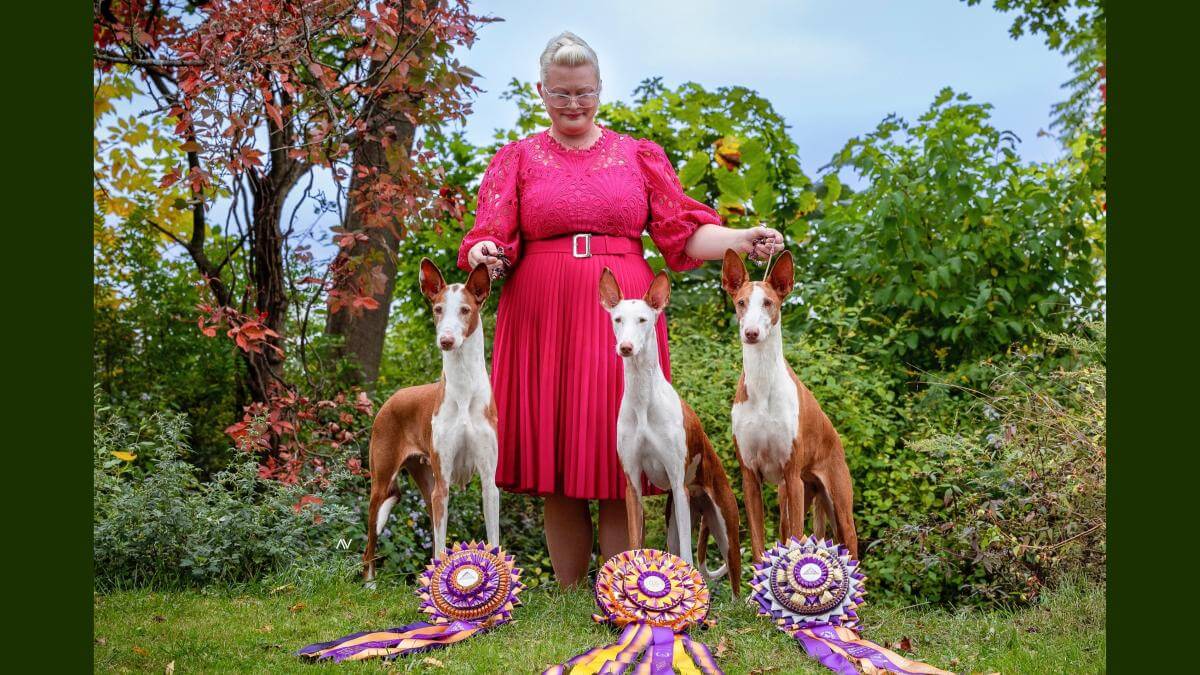
2025 AKC Hound Group Honoree Sarah Murphy shares insights on breeding, temperament, and presenting the Ibizan Hound.