Members
Richard Reynolds explores how judges should evaluate dogs when Breed Standards are silent on traits, faults, or conditions.
The Weekly Brief
The best of SHOWSIGHT editorials, weekly wins, and breeder commentary — delivered to your inbox every Sunday morning.
You’re a dedicated and knowledgeable Conformation judge. You’ve attended the seminars and hands-on workshops, and probably even hit up a mentor or two. Maybe you’ve judged a few Sweepstakes or some NOHS Groups. You arrive the night before the show and most likely spend the evening not with Gideon’s Bible but with that holy of holies, the AKC Book of Standards. You’re diligent, experienced, and dedicated, and you know the Breed Standard(s) through and through. Sometimes, though, that’s not enough.
The Standards, as you well know, attempt to paint a word picture of the ideal specimen of the breed(s) you are about to judge. You know it word for word, of course, and you still refresh your memory every single time. The Bible and other holy books are often subject to interpretation, the AKC Standards… not so much.
If you have been around for a few years—or in some cases, a few decades—you’ve learned a bit about dogs in general. Not just the Breed Standards but a whole panoply of facts, information, and (dare I say it) your personal preferences. You know a problem when you see it, but what to do about it? If your concerns are covered by the written Standard… no worries. You have tools at your disposal to reward an exhibit or not. You can even excuse or disqualify the less worthy. What happens, though, when the condition of your concern isn’t addressed or even mentioned by the Standard?
As the judge, you have a lot of latitude in your decisions, and if you follow published procedure, our friends at AKC will back you up 100 percent. That comes into play when the Standard is silent on an issue. The main requirement as per Rules, Policies, and Guidelines for Conformation Dog Show Judges is that each exhibit be individually examined and gaited before you take any action. Even if your concern is obvious the minute the dogs enter the ring (think of a green Poodle), only after individual examination can you consider the problem. But having said that, the gospel continues: “These Matters can be addressed in the manner in which the judge deems appropriate as long as it is in accordance with the Rules, Regulations and Policies of the American Kennel Club,” which, of course, leaves you pretty much back where you started.
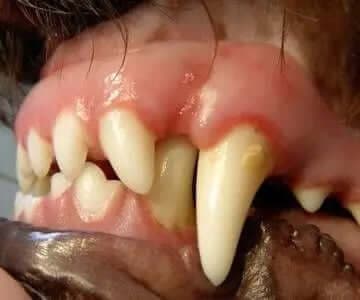
For an example, my own pet peeve is something called “Lingually Displaced Mandibular Canines” or “Linguoverted Canine Mandibular Malocclusion.” No matter what you may call it, it’s a damned big problem in any breed, but especially so in dogs that work for a living and whose most valuable tool in their kit is their canine teeth which serve as both tools and weapons. I find it almost impossible to award any dog with that condition, but so very many Standards deal only with the positioning of the incisors or full dentition, without specifying positioning.
The AKC Standard for the Dachshund, for example, requires powerful canine teeth but otherwise only a scissors or “even” bite. Nary a word about bad canine placement. The FCI Standard for the Dachshund, on the other hand, contains a disqualification for “faulty positioning of the lower canines.” Two Standards: one specific and the other requiring a judge’s decision. The AKC judge might choose to simply put the exhibit at the end of the line, might withhold an award, or might excuse the dog. Possible reasons for excusal would be “lack of merit” or “not consistent with Standard.”
Another possible example, and one that is frequently encountered, is color. The Standard for the Pointer lists four possible colors either alone or in combination with white, but immediately goes on to state: “A good Pointer cannot be a bad color.” That makes my head hurt. One truly knowledgeable judge excused a dog of another color stating, “Color not addressed in the Standard.” That is one way of doing it and it works! We encountered a similar situation when some Bedlington Terriers that appeared to be solid black in color appeared both in the show ring and in the field. There is no fault described for black color, but in two cases the dogs were excused. The BTCA is currently investigating the source of that coloration.
Another quandary arises in those breeds where a “floating rib” might be found. That’s the 12th or 13th rib that is attached to the spinal column but not the sternum. Floating ribs are both palpable on examination and often visible (especially on sighthounds) but not particularly problematic in most dogs, although they sometimes can and do cause more serious problems when displaced. While most Standards describe the desired anatomical conformation of the rib cage, few deal with, or even mention, floating ribs.
Sickle hocks and the movement that accompanies them are yet another anomaly that can occur in a wide variety of breeds yet is seldom addressed in written Standards. The condition is more common in those breeds which have significant rear angulation, and serves to restrict the amount of drive that the dog (or horse) can apply. Here again, sickle hocks are a condition that can and should be evaluated in the Conformation ring, yet because they may not be specifically mentioned in the Standard, are often ignored by judges.
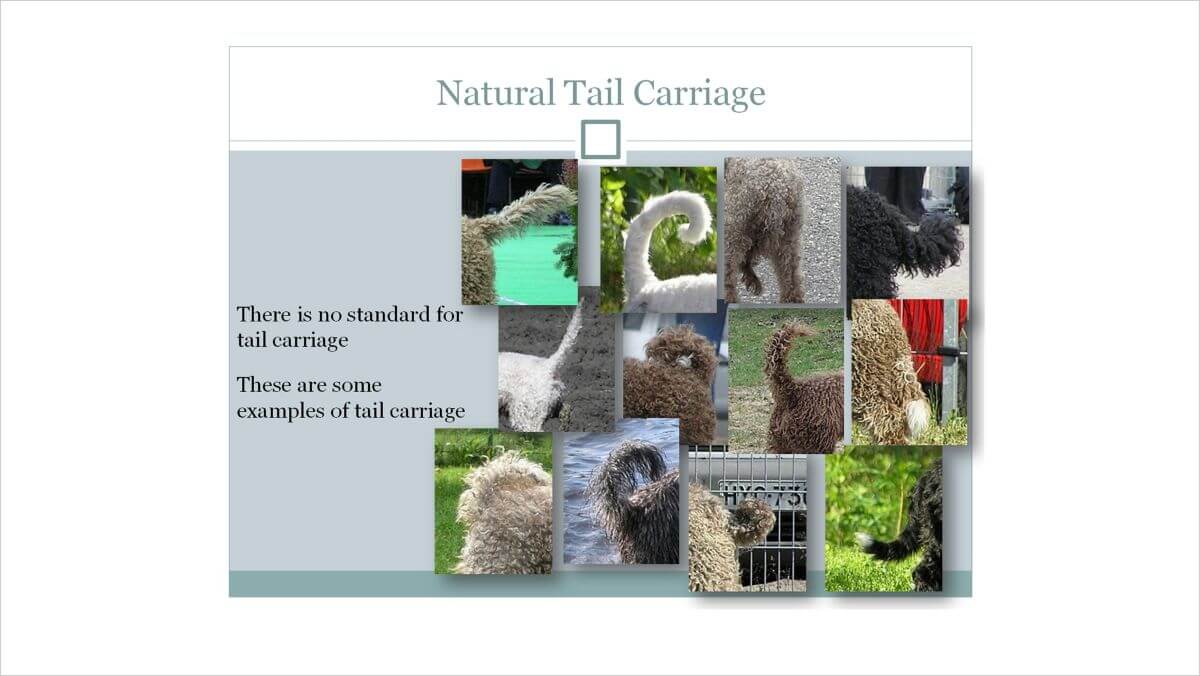
In newly recognized breeds, one may often encounter gaps in the written Standard. The original Standard for the Spanish Water Dog described a docked tail option for the breed, but the judges’ education program went on to mention almost every other possibility of tail description and carriage. In that instance, no tail was considered an anomaly, and to be honest, we suggested that judges basically ignore the tail as it was not sufficiently described in the first edition of the AKC Standard. (That was corrected in the 2022 Standard with good detail and guidance.)
In many instances, a parent club may be aware of these issues and deal with them to a greater or lesser extent in an Illustrated Standard of the breed. These are a valuable resource, and they supplement, but do not replace, the adopted Standard. They are guidance, but seldom provide a specific remedy.
The “Silent Standard” has been a long-standing problem for me as a Conformation judge. If you judge dogs long enough (or work them long enough) you’ll eventually encounter these issues which may not be mentioned in each Standard. I took the liberty of calling a highly placed official at AKC seeking his advice. He kindly explained that AKC recognizes a “chain of priorities” in the judging process. The Standard always comes first, but once that has been applied, judges may consider the overall health and condition of any given exhibit. Finding an anomaly not covered by the Standard, they may excuse the exhibit, stating briefly their reason for such excusal. “Lack of merit” does not seem to always fit. “Not consistent to the Standard” covers instances where the Standard may mandate one thing and the exhibit displays another. Many choose to simply not reward the exhibit, but one should consider the degree and effect of the deviation in choosing a course of action.
There’s a fine line here. On the one side are conditions that are clearly described as disqualifications or faults in the Breed Standard, and on the other side are numerous conditions that affect the overall appearance, health, and/or function of the dog that are not mentioned or are ambiguous at best. Provided you have applied (and complied) with the Standard first as well as all the positive attributes of the exhibit, a judge can and should consider those other elements which in his/her experience detract from the quality of the exhibit.
Beware that you do not get led into fault judging. Your “Silent Standard” issue may be just one detraction from an otherwise worthy exhibit, but after applying the Standard, you can and should bring your knowledge and experience to bear in the evaluation of other detrimental factors.
May the best dog win!

All About Judging